Showing posts with label middle-grade. Show all posts

Tuesday, 15 July 2014

review: Shipwreck Island

by S. A. Bodeen
Feiwel & Friends, July 29 2014
middle-grade fantasy
ARC received via publisher (thank you!)

Summary:
Sarah's dad and Marco's and Nacho's mom are getting married, and neither Sarah nor Marco are at all pleased (Nacho is on the fence). When the newlyweds decide to bring the kids on a family honeymoon, Sarah and Marco are sure it's going to be awful. But even they have no idea what they'll find on Shipwreck Island...
The cover:

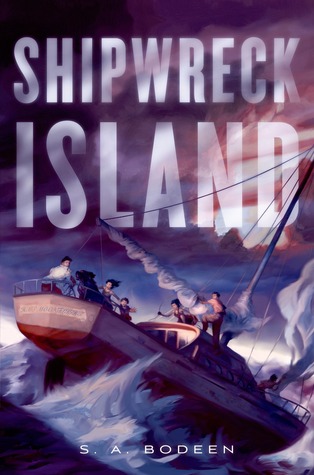
Illustrations that show entire casts of characters are the best, and the grand scale of the scene depicted here lends a suitably dramatic tone that accurately reflects the genre (if not the actual writing). The neutral font is spiced up with interesting shadow-masking effects, letting the beautiful turmoil of the art shine.

The book:

Well, this was a bizarre read. Shipwreck Island starts out promisingly, with the mostly authentic voices of Sarah and Marco alternating chapters. The built-in tension in their family structure helps move the pace along initially, even though there's no sign of a story arc.

But then it becomes clear that this is the book's major flaw. The action steadily rises, but Bodeen fails to introduce any other stakes, goals or personal engagement beyond life-or-death. All the characters want is to get back to the mainland alive, and dropping hint after fantastical hint regarding the truth of the island ups the tension but not necessarily the reader's engagement. Simply put, the draw of finding out what's going on is not enough when the characters are pratically passive in the actual discovering.

In fact, Nacho is perhaps the only character who is original enough to enliven the story. His interactions with Sarah and Marco not only go a long way toward rounding out our main characters (more than their actual points-of-view do!), they make him fascinating enough to warrant being a protagonist himself. The parents are bland at best, and with such a small cast of characters, it's no wonder this book is startlingly short.

The end is quite, quite abrupt (all the more so for the attempt at a Dramatic Plot Twist by adding a new character), and with the island's secret as yet unrevealed, Shipwreck Island is neither a very good standalone nor a solid first book in the series.

Ethnic balance: 3 out of 5. Marco, Nacho and their mother are presumably Latin@ (though it's never specified), and the new character has "dark" skin.

Rating: 2.2 out of 5

Tuesday, 24 June 2014

spotlight: The True Meaning of Smekday/DreamWorks' Home

It's always fantastic when big-name film studios pick up children's books and develop them into full-length motion pictures. This is exactly what's happening to a hilarious, thoughtful and ambitious middle-grade sci-fi novel: The True Meaning of Smekday by Adam Rex (Disney-Hyperion, 2007). So I thought I'd feature it and the movie adaptation, DreamWorks' Home (in North American theatres March 27 2015), in a little spotlight.


When I say this book is ambitious, I mean it. It's sci-fi that doesn't take the science parts too seriously (watch this animated short teaser from DreamWorks for a preeeeetty accurate picture of what the alien race Boov look like) but does approach the human aspect to it exceedingly well. The theme of family drives Smekday's plot; our protagonist, Gratuity (her friends call her Tip), sets out on a cross-America trip when her mother is kidnapped by the invading Boov. This makes her prejudiced against the aliens, including renegade Boov mechanic named J.Lo who becomes her sidekick, until her perceptions of what is right and who should win are knocked askew when yet another alien race approach to invade.

Structurally, this book is immensely fun. The novel starts out as an essay set by Tip's school to write an essay on the meaning of Smekday, and slowly evolves into a monstrous thing of fun from there. Adam Rex is also an illustrator (he illustrated quite a few famous authors' children's books, like Neil Gaiman's Chu's Day), and his pencil sketches dot the novel as pictures from the perspective of Tip's camera. Little six-page comics from J.Lo's perspective are also a rare treat.

You'll notice that this is DreamWorks' first animated film with a black female protagonist — well, you can bet that Rex doesn't shy away from addressing Tip's interracial family and the reception she gets when she tells someone "We're Italian". Then there's the Chief, a Native American who helps upend a few white privileged theories on their posterior as well. Basically, Smekday wins all the awards for racial diversity in a MG novel, which is why it's even more awesome that DreamWorks has made it into a film.


(You gotta watch the trailer just for the line "Oh, no! My hands are in the air like I just do not care!" The best.)

Rihanna voices Tip, and the Boov (now named "Oh") is voiced by Jim Parsons. Try not to freak out, now, but Jennifer Lopez is actually voice-acting in this movie. Yep, the author named his rogue Boov after her, and now she's going to be in his film as Tip's mom. Furthermore, Rihanna is recording a full-length concept album that will serve as this movie's sound track, which is all kinds of amazing.

Finally, here are ten reasons from Tip and J.Lo themselves, as illustrated by Adam Rex, why you should get onto this book & movie stat:


Sound good? Let me know if you have read or will read the book and/or will watch the film!

Thursday, 3 April 2014

review: Nick and Tesla's Robot Army Rampage

by Bob Pflugfelder and Steve Hockensmith
Quirk Books, February 4 2014
middle-grade contemporary
review copy received via publisher (thank you!)

Summary:
After solving a kidnapping, Nick and Tesla's summer hasn't calmed down just yet: their friend Silas's father just got robbed, and without the valuable comic that was stolen the family shop might go under. Then robberies start springing up around town, with the only suspects being a series of robots that are coming from the new owner of a shop... who their Uncle Newt just happens to be in love with!
The cover:

Whoever came up with the base design for this series is a genius. The blocking of "Nick and Tesla's" above the title makes it easy to swap out the new title for each book in the series, and the small details (the eyes in "Robot", the coloured rectangles to the right of the title, the gears) make this cover wonderfully easy on the eyes. Then, of course, there's the actual illustration: an excellent sense of movement draws our attention to our protagonists in the centre.

The book:

This sequel to Nick and Tesla's High-Voltage Danger Lab (which I also reviewed) is almost entirely an all-around improvement — which is something, considering I rated the first a 4.3 out of five. The humour is perhaps the standout: ramped up somehow, intangibly, there are a lot of funny situations and conversations which Nick and Tesla find themselves in, and the authors don't hesitate to use the most prominent adult, their Uncle Newt, for comic relief.
"You're just trying to provoke me," Nick said. "You know I'm just as good with electronics are you."
"Oh? How much you wanna bet?"
Tesla gave her brother a hard, challenging stare.
He was right about her trying to provoke him. But that didn't matter.
Because it still worked.
"How about five million dollars?" Nick said.
Tesla shook her brother's hand.
"It's on, dude," she said.
(p. 36)
A stylistic choice that separates this book from the first is the time spent in Nick's head; that is to say, the omniscient point-of-view is scaled back in favour of a more limited-third-person perspective in the form of Nick's thoughts. This is somewhat disappointing, given that Tesla's the only girl in the group of four friends (Nick, Tesla, Silas and DeMarco); it'll be interesting to see whether they move further into Nick's head in the next book, or switch to Tesla, or perhaps revert to omniscient. Nevertheless, both of our main characters feel authentic, and the strongest instances of characterization occur when their contrasts to each other are highlighted.

Once again, the secondary characters are beautifully developed: Silas and DeMarco get into plenty of trouble with Nick and Tesla, and their respective responses to each situation makes for humour and also insight into their characters. The adults involved are portrayed with efficient strokes (Angela, for example, needs only one page to establish her loquacity), and the introduction of new character Hiroko Sakurai is a positive for both drawing out another shade of Uncle Newt's character and also boosting the diversity in this book.

The propulsion of the plot renders it very quick-paced, yet still makes time for the series's larger arc involving the mystery of their parents' job and disappearance. Though there isn't much of a lead-up tension-wise to the climax, the plot twist ties into the final action scene nicely, and a last mysterious phone call pulls readers closer to the overarching mystery and the next book.

And of course, the science experiments! This time they're robot-themed, very diverse in scope and as before, well-integrated in the story. In fact, I continue to be awed by the way a concept book like this can integrate the story and the DIY part so well. At this point it's unsure how many books there'll be in this series, but from a reader's standpoint there isn't any reason to slow down yet. Full steam ahead with this delightful, original MG series.

Ethnic balance: 3 out of 5. Added one WOC, but she plays a major role, so I'll bump up the rating 1 whole mark.

Rating: 4.4 out of 5

Sunday, 23 March 2014

review: The Mark of the Dragonfly

by Jaleigh Johnson
Delacorte Press, March 25 2014
middle-grade fantasy/steampunk
ARC received via publisher

Summary (from Goodreads):
Piper has never seen the Mark of the Dragonfly until she finds a girl amid a caravan wreckage in the Meteor Fields. Anna doesn't remember a thing about her life, but the tattoo on her arm is proof that she's from the Dragonfly Territories and thus protected by the king. Which means a reward for Piper if she can get the girl home. The one sure way to the Territories is the 401 train, but stowing away is a difficult prospect—getting past the peculiar green-eyed boy who stands guard is nearly impossible... Life for Piper just turned dangerous. A little bit magical. And very exciting, if she can survive the journey.
The cover:

It is so, so static. The ARC's back cover features a much more interesting illustration featuring the three main characters in motion on the important 401, and one wonders why the designers instead went with a boringly symmetrical symbol which has no hint of uniqueness to it, along with a standard sans-serif all-caps font only slightly re-arranged.

The book:

The writing in this book is rather sub-par, and this is evident from the first few pages. Jaleigh Johnson tells rather than shows often ("Piper was too tired and worried to deal with this mess." p. 43) and stuffs world-building exposition into her dialogue throughout the book, so that her characters give half-page speeches on technology, races and politics. This problem exacerbates the unrealistic dialogue Johnson occasionally places in the mouth of her protagonist; in Piper's conversations with Anna, the former often sounds more like a mother ("That's my girl"; "Put that incredible brain to use") than the sister which the characters soon come to resemble.

But now we come to the many good aspects of this book. The relationship between Piper and Anna is wonderfully developed and essentially everything kidlit doesn't tend to have in a girl-girl friendship, especially given the very interesting — and later telling — characterization of Anna, who is truly endearing. If I may say so without spoiling anything, their relationship is also intricately tied into the magical aspect of this otherwise-steampunk book, and furthermore related to the plot. These layers are basic, but also not too common, which makes them all the more awe-some, in the awe-inspiring sense.

The plot is also strong; one of the easiest ways to check for pacing is to see where the main action events take place, and in The Mark of the Dragonfly Piper, Anna and green-eyed Gee run into different sorts of trouble in a town, onboard the train and in a dramatic mansion in the climax. In between, Piper and Anna have enough mysteries to unpack that there is a near-perfect balance of slow and fast scenes. (Indeed, Piper's scenes with Gee are made all the more touching for the excellent pacing. Though I do have to insert a complaint about his green eyes making him all ~special~ here. He's a chamelin — why does he need to be any more special?)

Now, the worldbuilding. In retrospection, the beginning is slower as Piper's old way of life is detailed, yet the amount of set-up Johnson leads us through doesn't feel quite enough somehow. There remains much about the politics of the entire planet to be explained, especially considering the ramifications which Anna's past (well, present) is supposed to have on the kingdom. Piper's magical ability is an interesting introduction of fantasy, and the meteor showers themselves are a potential-laden concept which hint at other worlds. Enough substance is there to provide a firm foundation for the forthcoming companion novel, which according to the author's website will feature different characters.

Overall, if you can overlook the awkward writing and dialogue, The Mark of the Dragonfly is a well-paced and richly-characerized novel that does justice to the genre of steampunk and the age category of middle-grade.

Ethnic balance: 2 out of 5. An interesting, non-Western-sounding selection of names for cities and towns, but no mention of ethnicity beyond Gee's "olive" (ugh) skin.

Rating: 4.1 out of 5

Tuesday, 26 November 2013

review: Nick and Tesla's High-Voltage Danger Lab

by Bob Pflugfelder and Steve Hockensmith
Quirk Books, November 5 2013
middle-grade contemporary
review copy received via publisher (thank you!)

Summary:
Nick and Tesla's parents dumped them in small-town USA to live with their eccentric uncle for the summer, and they're not exactly sure what they're supposed to do for two months. Turns out their uncle is a pretty cool, if kooky, scientist, and the assorted materials and gadgets to be found in his house are just what Tesla and Nick need to solve the mystery lingering about their new neighbourhood.
The cover:

Lovely! The colours are clean and bright, and the illustration style is wonderfully suited to a middle-grade novel; the sense of movement in the art makes for an engaging, attractive cover. The fonts are well-situated and pleasingly embellished, without being too decorated.

The book:

Omniscient voice never worked so well as in middle-grade. Nick and Tesla are characterized in a few brief, efficient strokes, and the narration dips into both their heads for the occasional internal thought to further develop them. Their sister-brother dynamic is wonderfully authentic and delightful fun to read, making their interactions with the friends they make all the more heartwarming.

And oh gosh, the secondary characters are good. Silas and Marco's interactions -- banter, really -- and a few scenes with their family help to develop them as fully as Nick and Tesla. Their contributions to Tesla and Nick's escapades only further endear them to the reader.
"Pleasure doing business with you," Elesha said as she folded the bills and stuffed them in her pocket. She cocked an eyebrow at her brother. "Good acting, crybaby. Or was it acting?"
DeMarco showed her his fist.
"I'll show you what real crying is, if you'd want," he said.
"Ha. As if you'd dare."
Elesha turned her back to DeMarco, flipped her cornrows over her shoulders and went sashaying away.
"Your sister is one tough second-grader," Nick said.
DeMarco shivered. "You should meet the one in kindergarten." (p. 135 - 136)
The plot unfolds on two levels: the self-contained mystery arc develops briskly and enjoyably, while the larger, series-wide arc concerning their parents is established slower, a hint dropped here and there. This sets up the anticipation that will carry readers into the next book, while the book-by-book mysteries will keep them going.

Perhaps the most unique aspect of Nick and Tesla's High-Voltage Danger Lab is the four or five DIY science experiments that come with complete instructions and neat illusrtations. These experiments are perfectly integrated into the story itself, which goes to show their real-life practicality. I'm positive these experiments will be happily received by any adventurous kid, science-minded or not.

Ethnic balance: 2 out of 5. DeMarco and his family are POC, yay.

Rating: 4.3 out of 5

Saturday, 5 October 2013

review: The Desperate Adventures of Zeno and Alya

by Jane Kelley
Feiwel and Friends (MacMillan), October 15 2013
middle-grade contemporary/anthropomorphic
ARC received via publisher

Summary:
Zeno, an African grey parrot abruptly orphaned in the middle of Brooklyn, knows he is a beautiful, brilliant bird, but that knowledge won’t help him survive in the concrete wilderness. Alya, a girl with leukemia, is caught between surviving and not trying anymore. If they ever find each other, they may re-find the hope that comes with newfound friendship.
The cover:

The light colour-schemed illustration style makes this cover seem much more idyllic than the actual story, but it nonetheless fits for an MG anthropomorphic novel. The expanse of sky framing the lovely brownstone buildings has a beautiful texture to it. However, the title doesn’t have enough space to do its elaborateness justice.

The book:

A short, sweet novel, The Desperate Adventures of Zeno and Alya is unconventional, and mostly successful in its efforts. Zeno’s narration is wonderfully idiosyncratic and completely credible; his voice creates a personality for an African grey parrot that you can fully imagine. Alya’s internal narration is also believable for a young, sick girl, a girl who has been sick for a long time. Jane Kelley occasionally jumps out of her protagonists’ head to a side character, puzzlingly, but it happens rarely enough that one may disregard it.

The plot is nothing special. It’s a good thing this is a short book; otherwise the repetitive action of Zeno getting sidetracked on his way to Alya’s window would get too boring. This isn’t helped by the rather heavy-handed messages and lessons Zeno learns in regards to friendship and life in general. Nevertheless, when he hits his lowest low, the reader’s empathy will likely be stirred.

Things pick up at the end as heartstring-tugging interactions between Zeno and Alya fill emotionally-fraught scenes. Alya’s family (particularly her brother Parker) are remarkably well-developed considering their scant pagetime, and they make the closing sequences more touching. And the final scene, the interaction between Alya and Zeno is a poignant tying-together of all the themes introduced throughout the story. From Zeno removing her cap to the idea of escapes to the naming of his friend… not ashamed to say I teared up a little.

Ethnic balance: N/A. One family and a bunch of birds.

Rating: 3.8 out of 5

Tuesday, 10 September 2013

interview & giveaway: Claudia Mills, author of Zero Tolerance

As part of the blog tour for Claudia Mills and her latest contemporary MG Zero Tolerance (which I loved, as you can see from my review), I'm incredibly honoured to be able to interview Ms. Mills herself on Zero Tolerance. And once you've finished reading the interview, don't forget to enter the giveaway to win one copy of Zero Tolerance yourself!

Find Zero Tolerance on Goodreads or Amazon.

Welcome, Ms. Mills!

1. First, I have to ask: is any part of Zero Tolerance based on real life?

First, I have to say, thanks for hosting me on Pass the Chiclets today!
Sierra’s threatened expulsion from school for an innocent mistake was based on an actual incident that took place a few years ago in a middle school near my home in Boulder, Colorado, when an honor student faced serious sanctions for bringing a knife to school in the wrong lunch. I don’t even remember how that story played itself out; I just remember thinking how much the student in question would have to rethink so many of her fundamental assumptions about how her world worked.

It's so fascinating that you took a real-life situation and spun an entire story from it! I wonder if the student will ever read Zero Tolerance herself...

2. Sierra has a group of girlfriends who often share pagetime in their interactions with Sierra. How did you ensure each of her friends had a distinct personality?

Unlike some of my fellow authors, I don’t keep a notebook of personality traits and distinguishing features of each character. It seems a bit strange to say this, but I just somehow enter into the scene as I write. I hear the characters talking, see their gestures and glances, as I’m writing it all down. I feel as if I’ve eavesdropped on their conversation. Sometimes that makes revision difficult for me, as the original scene feels so real, the way “it really happened.”

Amazing! It's always interesting to learn about the writing process, and it's very intriguing that your scenes are almost cinematic for you.

3. I adored the budding romance between Sierra and Luke. What was your favourite scene of theirs to write?

“Good girls” are always attracted to “bad boys,” aren’t they?
I think my favorite scene was in Chapter 14, when Luke opens up to Sierra for the first time, as he tells her about “Backwards Day” in kindergarten and about his parents’ quarrels over how to respond to his alleged attention deficit disorder. I always love the moment when characters first make a genuine connection.

Haha, I suppose they are. And yes, I loved that moment too, so much that I actually quoted it in my review!

4. Sierra's mother and father have a very push-and-pull dynamic. Was this challenging to write from Sierra's perspective?

I grew up in a much happier family than Sierra’s in many ways, but I still remember vividly the few moments of conflict my parents had: those memories are seared into my heart. And I know my own two boys had to listen to occasional moments of parental argumentation that they would rather forget. So I tried to tap into the universal awfulness of being a child witnessing parental discord, while being so powerless to intervene in the situation.

5. Are there any outtakes which you really loved and were particularly sad to cut?

Yes! Initially I had Sierra write not one but two letters from the school secretary’s computer. The second letter was a love letter from Ms. Lin to the principal, Mr. Besser. I adored the scenes when Mr. Besser is now trying to avoid Ms. Lin and finally has a confrontation with her about it. Delicious! But both my writing group and my editor thought two letters was one letter too many, so that one had to go. Wah!!!

Oh my gosh, that sounds hilarious and so fun! I so wish we had been able to read that scandalous letter.

6. What's the one scene or aspect of Zero Tolerance you hope readers will remember?

It’s the scene in the hallway during the expulsion hearing, when Sierra has to decide how she wants to respond to her father’s carefully laid plans to destroy the principal. So much is at stake for her in that scene. What happens during those few minutes in the hall allows Sierra to define her own identity and decide what kind of person she wants to be.

Oh yes, that scene resonated with me, and I could understand how Sierra's journey was coming to a defining moment. It's great to hear how important to you it is.

Thank you for the wonderful questions, Eden, and for giving me this chance to share my book with your readers.

Thank you so much to Ms. Mills for this interview! And now... you want to win a copy of Zero Tolerance, right? You know you do. So go ahead and enter! This giveaway is open to Canadian/US residents and ends September 24, 2013.

a Rafflecopter giveaway

Sunday, 8 September 2013

review: Spirit Animals: Wild Born

by Brandon Mull
Scholastic Press, September 10 2013
middle-grade fantasy
review copy received via publisher (thank you!)

Summary:
In a world where spirit animals come to only a few, Conor, Abeke, Meilin and Rollan each drink the Nectar… and each call forth one of the Fallen Four, a legendary group of animals who died to stop an ancient war between the Greencloaks and the Devourer. The appearance of the panda, leopard, falcon and wolf can only mean one thing: the Devourer is back.
The cover:

It. Is. Fabulous. The illustrator—Angelo Rinaldi—has the perfect style for a middle-grade fantasy: not too cartoon-looking, but dramatic and detailed. I hope Scholastic paid him lavishly, because look at all those details—the beautiful background, the POC characters, the significance of the cloaks, the positioning of the animals and characters… oh, and the typography is pretty darn good, too.

The book:

This is Scholastic’s next interactive multi-author series, a direct descendant of The 39 Clues. With this series, they branch into the fantasy genre, with big name authors to go along with it (seriously: Maggie Stiefvater writes book 2, Garth Nix writes book 3, Shannon Hale writes book 4 and Marie Lu writes book 7). I was skeptical heading in, since from my experience multi-author series have minimal character development and the plot takes precedence over everything. While I can’t say my fears were unfounded, the reading experience was, for the most part, positive.

So, yes. Each character doesn’t have much of a voice. One gets a general sense of each protagonist’s general personality and chapters are written from inside one of the protags’ heads, but there’s no real sense of engagement. This is not aided by the surprisingly clunky writing, considering Brandon Mull’s extensive résumé.

But if there’s one thing that can make up for dry, neutral narration, it’s the diversity (in fantasy, no less!). There’s an even gender split (in the protagonists, at least, if not in the secondary characters), both girls are POC and the four major countries are clearly based off the Americas, Europe, Africa and Eastern Asia: Amaya, Eura, Nilo and Zhong, respectively. (The renegade country, incidentally, is Australia, or Stetriol.) One hopes that as the series goes on, authors take advantage of the diversity and develop the cultures of each protagonist more fully.

The plot is rather stationary for the first two-thirds of the book, as our protagonists are introduced and slowly brought together for training and info-dumping. Still, this is a short book, and each chapter is brief; readers will most likely not find the going slow. The climax gets messy even as it gets more exciting; the sheer number of characters almost guarantees it. With a hook-y ending, Wild Born is all that one can expect from a multi-author MG series.

Ethnic balance: 4.5 out of 5. Seriously guys, I almost cried with joy when I saw the cover.

Rating: 3.3 out of 5

Wednesday, 21 August 2013

review: The Heartbreak Messenger

by Alexander Vance
Fiewel & Friends (Macmillan), July 23 2013
middle-grade contemporary
review copy received from publisher (thank you!)

Summary:
Quentin doesn’t really see anything wrong with being the Heartbreak Messenger. He delivers break-up messages, he gets paid, and his mother gets to be a little less worried about money for paying rent. But as he gets deeper and deeper in, the emotions involved on all sides start to make it clear that there’s nothing simple about love—especially when he receives a break-up message for his best friend Abby.
The cover:

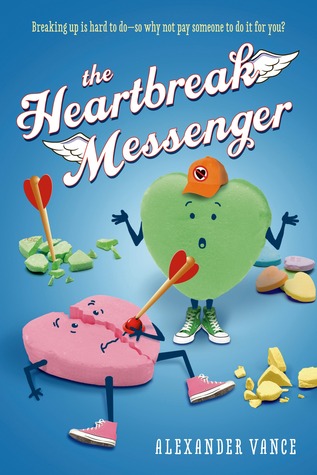
Oh, God. Can I just… not? I mean, the script font by itself might be okay, but the wings are just over-the-top. And the anthropomorphism of candy hearts! Who thought that would a be good idea? Who thought it would be representative of the book? I feel awful for the author. :/

The book:

The Heartbreak Messenger is a fun, light contemporary that deals with love (or “like”) from an interesting perspective. Quentin is the perfect narrator for this kind of story; he’s considerate, occasionally bumbling, but also genuinely thirteen-year-old boy. You know:
At the front of the room sat half-a-dozen refreshment tables stacked full of sugar, fat, frosting, and whatever the other food groups are. They were like heavy cargo ships ripe for plunder. (p. 38)
He and Rob are a wonderfully unpretentious, down-to-earth pair of friends, making for a marked contrast with Abby. The novel is a quick read, and due to its length we only get very brisk, drama-filled scenes with Abby, which is unfortunate; not only does it render the possibility of a tendre between her and Quentin implausible, but it stunts Abby’s growth as a character.

But perhaps that’s to be expected, given the very large cast Vance introduces in the course of 280 pages. And the different personages are what give this book its texture, given the rather simplistic plot which might’ve been solved had Quentin sat down for an upfront conversation with his mother. Speaking of which, his mother is a delightfully-developed adult character (three cheers for non-evil adults!), and together their conversations give the (relatively) heavy topic of Quentin’s errant father its due.

Despite the straightforward story arc, The Heartbreak Messenger is a well-paced read, and its pure middle-grade-ness will likely please MG fans:
As I stood there, the two old ladies stepped up beside me to stare at Justin’s candy dish commode.
“Well, I have to say, that looks like a toilet full of candy to me,” said one.
“Better than a toilet full of something else,” said the other.
They both cackled. (p.48)

Ethnic balance: 2 out of 5. A girl named LaTisha has “big hair”, but otherwise we’ve got a horde of names like Samantha, Bethany, Lizzy, Karyn (?!), Ty, Duke, Lisa…

Rating: 3.5 out of 5

Tuesday, 6 August 2013

review: Zero Tolerance

by Claudia Mills
Farrar, Straus & Giroux, June 18 2013
middle-grade contemporary
ARC received via publisher (thank you!)

Summary:
Sierra Shepard is the perfect seventh-grader, but she never expects an accident--bringing her mother's lunch, which includes a knife, to school--to land her in in-school suspension. Thanks to her school's ironclad zero-tolerance policy regarding drugs and weapons, Sierra must spend her days with other troublemakers, including classmate Luke, until her expulsion hearing, which even her attorney father may not be able to win.
The cover:

Ohhhh dear. I love the font, especially since it looks almost hand-lettered, and the way the author's name is lowercase and the title is in all uppercase. However, the illustration is simple--too simple, and it really doesn't evoke anything of the story or its style. Disappointing.

The book:

I received this ARC before the pub date, obviously, and I let it fall by the wayside--something I regret immensely now, because holy freaking goodness this book is good.

Claudia Mills absolutely nails the voice. Sierra is a perfect student, yes but she's also eminently relatable and simply wonderful to read about. Her third-person point-of-view never feels distanced; it almost feels like a first-person narration, which in itself should be an excellent indicator of how well-developed Sierra is.

This novel is somewhat short, so we don't get as much pagetime for Sierra's friends; however, they're all distinguishable and distinctive, even in something as basic as their individual texts. Sierra's mother and father have perhaps the second-most interesting dynamic of all relationships, second only to Sierra's relationship with Luke. Because Sierra + Luke? Well, this is how MG friendship-to-romance is done, guys. (It makes me want toreturn to middle school and find my own delinquent crush.)

The plot is tidy and realistic, and it wraps up almost too soon--but it leaves the reader with just the right amount of room to imagine all sorts of possibilities. And now I'm going to use the remaining room in this review to quote. Please indulge me. :)
For the second time that morning, Sierra's eyes stung with tears.
Luke looked up from whatever he was killing and dismembering in his game.
"What is it now?"
"I didn't get to fire my pot today," Sierra told him.
Luke shook his head as if to  clear some obstruction from his ears that was keeping him from hearing her properly. "You smoke pot?"
"Not that kind of pot! The clay pot I was making in art class. Today was the day it was supposed to go to the kiln to be fired."
Luke still looked puzzled. "And you're crying about it?"
Sierra nodded. "I loved my pot."
"You loved your pot," Luke repeated. "Okay."
"You don't love anything about school, do you?" Not that it was any of her business, but if she wasn't going to be trying to keep up with her schoolwork anymore, what else was there to do except make herself sad over her poor, orphaned pot or talk to Luke Bishop?
"Can't say that I do."
"Did you ever? Like in kindergarten? Did you like being in the Pilgrim play at Thanksgiving? Or making a cast of your hand in plaster of paris to give to your parents at Christmas?"
"I liked one day," Luke said. "It was called Backwards Day. We put our clothes on backwards, and zipped up our coats in the back. And the whole day went in backwards order. We started with resting time instead of ending with resting time, and we ended with the Pledge of Allegiance instead of starting with it. I thought it was totally cool, Backwards Day."
"So what happened after that? To make you stop liking school?"
Luke shrugged. "The rest was all Forwards Days. I don't do so well on Forwards Days." (p.70 - 80)
"Luke!"
His expression had changed from scornful anger to something that looked like hope. Hope that she'd look at him the way he had seen her look at Colin [her former crush]?
"Luke..."
Impulsively she hugged him, even though she didn't want to give him the wrong idea, the idea that she liked him, as in liked him liked him.
But as he hugged her back--he was taller than Colin and broader shouldered--as he stood, not hugging her anymore but just holding her, she worried that she might be giving him the right idea. (p. 193)
Ethnic balance: 1.5 out of 5. Lots of white-sounding first and last names, with only one kid in suspension with a "dark complexion".

Rating: 4.6 out of 5

Friday, 19 July 2013

Summer Series #6: Linna @ 21Pages

[What is the Summer Series? Read them all from the start.]

Not only is Linna one of the most eloquently wise people I know (seriously, check out her blog & discussion posts on middle-grade), she also always tells it like it is. And today, she's recommending Liar & Spy by Rebecca Stead! Welcome, Linna!

***
Liar & Spy by Rebecca Stead
Wendy Lamb Books, August 7 2012
middle-grade contemporary
"Nothing makes me warm up to a book more than a sense of empathy for the narrator (and an oddball cast of characters, and a perfect sense of humor, all of which Liar & Spy has in spades, but I digress). Georges (yes, with an 's') has enough to worry about without having the kind of name that inexplicably makes him a target to get picked on. Maybe that's what draws him to Safer, a strange kid in his new apartment complex that he meets after inadvertently joining his spy club. It's a simple story about friendship, more straightforward than When You Reach Me, but that focus on people over plot is a different kind of wonderful.
I loved almost every character, no matter how small of a role they played - in a book so short, even a single line of dialogue had so much to say about someone's personality. Most of all, I loved it for its humor. Georges' only-sane-man narration and frank wit, small quips between siblings and teachers and neighbors, all this sense of history between the cast - it's like taking a peek at the goings-on in their lives, and being left with the feeling that it'll all continue even after turning the last page. I only wish that the book wasn't so short - the ending feels rushed, and there were so many more hints of depth to characters that weren't fully explored."
***

I admit that I didn't like When You Reach Me, but hearing that this is more character-based, I think I'm going to pick it up! Plus, I'm always up for a good MG... especially when recommended from Linna. :) Have you read this one? Will you try it with me?


Sunday, 23 June 2013

top five: non-human characters

Human characters have it easy: we as readers relate to them immediately to some degree because they're, well, human. But it takes skill on a writer's part to turn a non-human character into a hero. And when they do, I love it. Like, seriously love it. Read on and you'll see. :D

5. Grimalkin, The Shadow Dragons by James A. Owen

This cat has historical, mythical, magical and legendary secrets pouring every which way out of him. In the series (the Imaginarium Geographica), he has symbolic and physical importance, and he represents betrayal, ancient history and the most fantastic of the fantastical to the main characters. Grimalkin also spouts riddles at every turn, confounding almost everyone who speaks with him, which makes him that much more entertaining to read about.

4. The city, The Summer Prince by Alaya Dawn Johnson

The only reason the city isn't rated higher is because we don't get enough of her! Alaya Dawn Johnson's fantastic world is entwined with the city of Palmares Tres, and the city herself is sentient. She's fully aware of the divide between the poor in the verde and the rich in Tier Eight to Ten, and she's wise but distant, caring but omniscient. And when she becomes intricately tied to one of the main characters in this book, well, let's just say I had my heart broken a little.

3. Hake, Icefall by Matthew J. Kirby

Pride and brutality define Hake. His battle prowess and confidence as captain make him easy to admire, but it's when his power and vulnerability are juxtaposed that his character is completely endearing. Add in that loyalty that makes him strong from the core, and he makes for a fantastic friend too, even as he tentatively reaches out to the protagonist.

2. Taggle, Plain Kate by Erin Bow

If Taggle didn't make you laugh, snort, grin like crazy and then cry, then you have no heart. I'm serious. This cat is written more haughtily than your fourth-year English university professor and yet when it comes to Kate, he's a total softie. That juxtaposition completely won his way into my heart, and when he makes that sacrifice for Kate... ugh. Pass me the tissues.

1. Tool, The Drowned Cities by Paolo Bacigalupi

Though he makes his initial appearance in the companion prequel Ship Breaker, Tool comes into his own in The Drowned Cities—and boy does he take the stage. He wields his half-man, half-dog/cheetah/jackal/etc. status bitterly yet proudly, and his outlook on life and survival in Bacigalupi's harsh world is unflinching and effective. He's kickass, in other words, and when his vulnerable side comes out (which is nearly never), he'll make your heart melt.

(And, if you're me, he'll have you going "don't go Tool please I love you don't go don't go"—but. You know. That's just me.)

Thursday, 11 April 2013

review: Gustav Gloom and the Nightmare Vault

by Adam-Troy Castro; illustrated by Kristen Margiotta
Grosset & Dunlap (Penguin), April 18 2013
middle-grade paranormal
ARC received from publisher (thank you!)

Summary:
Fernie What's new friend Gustav Gloom can't leave his front yard, and his house is full of sentient shadows. But things get weird -- well, weirder -- a lot faster when an ice cream man-slash-shadow eater shows up, demanding for the Nightmare Vault. As secrets about Gustav's past are revealed, Fernie and Gustav race to stay one step ahead of the shadow-eater... and the potential demise of their world.
The cover:

There's something off about this cover. I don't think the diagonal skewing does it any favours, and the odd lighting plus lack of background context sort of washes out the illustration. The door is a nifty transparent foil to the image behind the cover, though, which is cool and should totally happen more.

The book:

The reason why I love middle-grade (well, one of the myriad reasons, at least) can be found in the style of this book. Written in third-person limited from Fernie's point-of-view, the narration is filled with sly, deadpan humour and simple but telling details that mark this as middle-grade:
"The man walked into my house and ate my shadow. Don't you think I might have a few things to say?"
Gustav seemed a little stunned and humbled by the reminder. "I'm sorry, Fernie. I almost forgot all about what he did to you. You're right. That was pretty rude of him, too."
"Not just pretty rude," Fernie said. "Cosmically rude."
Gustav seemed to appreciate that. "He is a big jerk, isn't he?"
"And he's smelly," Fernie added.
Gustav cocked his head a little. "I know I never got all that close, but I didn't notice the smelly part. Is he really?"
Fernie thought back to her first meeting with the man. "No. It's just something else to say as long as we're calling him names. He wasn't smelly. We can erase the smelly."
"That's not necessary. I'm perfectly okay with calling him smelly. I was just checking." Gustav held the door open for her and offered her a little bow. "After you." (p. 117)
The writing isn't perfect; you'll see in the above quote two instaces of "Gustav seemed" at the start of sentences, and proper nouns could often be replaced by pronouns. Occasional telling instead of showing occurs, which grows irritating as a lot of random running action is described.

But it's easy enough to forgive all that with Fernie and Gustav at front and centre: their friendship develops with all the growing pains an MG relationship desrves, even though this is a sequel and their friendship is already established. Gustav's backstory is intriguing enough to make me want the third book in the series, and Fernie's sister and father are just plain awesome.

The paranormal aspects are well-done but not over-done, and there's enough of an overarching plot to assure readers that this isn't a series full of one-shot adventures. And so I hereby proclaim middle-grade paranormal to be the next big trend. ;)

Ethnic balance: 1 out of 5. Unfortunately, only one family is mentioned, and the rest are ghosts, so...

Rating: 4.2 out of 5


Tuesday, 26 February 2013

not-so-original premises: book ideas already written

Remember everyone heralding Across the Universe as a supremely original sci-fi with an unguessable twist?


Meet Dom Testa's Galahad series, the first of which was published in 2004 -- seven years before ATU came out. Compare the summaries of Across the Universe and The Comet's Curse, and you'll see immediate similarities. And having read both, I can tell you that the similarities run true in the book. Teens get launched into space, in charge of a spaceship being sabotaged, while in the background medical science is developed.

And yes, I guessed the true antagonist from the moment he was introduced.

I'm not bashing or defending the books; my goal here is to point out that no idea is truly original. So when you're lauding a book, saying it's got a fabulously original premise is not the way to go.


Some more examples:

Veronice Rossi's Under the Never Sky (2012) and the MG dystopian A Crack in the Sky (2010) by Mark Peter Hughes (click titles to see Goodreads summaries).


I've read both these two as well, and I can tell you -- the worldbuilding (which was one of the main the selling points of UTNS around the blogosphere) is almost exactly the same: protected pods amidst a barren wilderness, using a grand disillusionment on the protagonist's part to fuel the central conflict. Click through the links up there to see the summaries, guys. See for yourself.


And finally, one forthcoming book that I haven't read compared with a classic: Eve Silver's Rush (2013) and Monica Hughes's Invitation to the Game (1991).


Click through, read the summaries, and tell me if you don't see a resemblance.

From my perspective, these matching premises are usually only a big deal or worth noting if the book is high-concept; contemporaries, for example, often bear similarities, which is to be expected. But the trouble starts once a premise's apparent originality becomes a selling point of a novel. In the end, we need to judge and promote books based on their actual quality. After all, a good premise never makes up for poor execution.

Tuesday, 29 January 2013

review: Malcolm at Midnight

by W. H. Beck; illustrated by Brian Lies
Houghton Mifflin Harcourt, September 4 2012
middle-grade anthropomorphism mystery

Summary:
Malcolm is a rat. But when everyone in his new school seems to have something against them, he's fine being mistake for a mouse, even if it means lying to the Academy, the society of classroom pets he is newly initiated into. But when Aggy, their iguana leader, goes missing and Malcolm's identity is revealed, clearing his name means he'll have to find the real suspect... and maybe uncover a few secrets of the school itself.
The cover (illustrated by Brian lies):

Major props to the designer (whose name I would mention if I could find it :S) and illustrator; this could've easily gone cheesy Redwall-style, but it didn't. With the shadowing and illustration style, this cover evokes just the right timeless mystery atmosphere. The clock is a great feature since it plays such a pivotal role, and the title font is bold but serif-ly stylish.

The book:

Let's talk about this book's narration, because holy wow is it unique: written to the class's teacher from the students, the narrator addresses him as "you, Mr. Binney". It's subtle but effective. And footnotes linking to "vocabulary words" or hilarious commentary on specific students in the class are definite funny highpoints, a burst of awesome in each chapter.

That being said, Malcolm isn't distanced at all from the reader due to the narration style. In fact, it'd be nigh impossible not to relate to him, thanks to the identity struggles he goes through. His interactions with the students and other classroom pets alike make him utterly endearing, someone to cheer for.

Speaking of the students and pets -- alll of the side characters are so amazingly developed it's mindboggling. The little quirks of the students and teachers both flesh them out and create that tangible, authentic classroom air. The pets are larger-than-life, from the tarantula (Lance?) to the sister-and-brother hamster duo. Even minor characters like Snip and the barn owl (sorry, I'm forgetting names) are very much 3D. Also, my favourite human? Johan. (Hopefully I'm remembering his name right...!) THIS KID, GUYS. <3

Now, the mystery. Oh, is it a mystery. Red herrings, multiple suspects and hidden motivations propel this storyline non-stop as Malcolm adventures throughout the whole school and even to the great outisde. Beck uses her entire school to map out the action, from the creepy, disused 4th floor to the underground boiler room.

Malcolm at Midnight also has: a villain you can empathize with. A twist-and-turn mystery. And hilariousness when you least expect it. This is by far my best read of 2013 so far.

Rating: 4.6 out of 5

Wednesday, 9 January 2013

top five: books to reread in 2013

Idea shamelessly stolen from Chloe @ YA Booklover Blog.

Some books only sink in on the second time around. Some books are the perfect kind of pick-me-up for any time. And some books are so good you just have to read them again. So here are my top five books to reread in 2013!

5. Okay For Now by Gary D. Schmidt

This book is heartwrenching. There are so many truths in the story but also so much emotion that can only be truly understood and parsed through on multiple read-throughs; it's like you empathize so much more what Doug goes through once you see his actions through a different filter. Also, I want to see if I cry this time around.

4. Third Transmission by Jack Heath

The first time I read this, the ending stopped my heart. It blanked out all other impressions I formed, and so I definitely need to reread and appreciate all the action and secret plans. And this time round, I'll be prepped for the twist ending. And maybe I won't toss the book on the floor in despair. Maybe. Probably.

3. Five Flavors of Dumb by Anthony John

My favourite contemp of all time. :) I'm excited to reread and watch Piper's relationships form with the band and Ed and also read all of the scenes involving Finn, who's basically the best fictional younger brother ever. This book talks about girl power and parents and sacrifices, and it does it all supremely.

2. Ender's Game by Orson Scott Card

I read this in 2012, and oh. my. lord. Mind-blowing. And so, so, so sad. Rereading this one is going to be an odyssey of a journey; all the themes and questions I talked about in my discussion post for Ender's Game are going to crop up again and there won't be any new answers and this will wring my heart out of my chest. I know.

1. The Summer Prince by Alaya Dawn Johnson

This book comes out in March 2013, and I'm definitely going to need to reread it before writing a review. It's colossal. Not in terms of page count, but it's so ambitious in worldbuilding and themes, and it SUCCEEDS, guys, it succeeds. The execution is so wondrous that the world feels real; the characters are so multi-faceted, in fact that I'm a little bit scared of them. I kind of want the whole world to read this book.

Thanks for reading! Do you have any rereads in mind for 2013?

Sunday, 18 November 2012

review: The False Prince

by Jennifer A. Nielsen
Scholastic Press, April 1 2012
middle-grade fantasy
received from publisher (thank you!)

Summary:
Sage has been plucked out of his orphanage and thrown into a noble named Conner's treacherous plan: he and three other orphans will fight for the chance to impersonate the long-lost Prince Jaron. Death is guaranteed for the boys who aren't picked. Sage knows he must win, for reasons hidden by layers of lies which will rock the land of Carthya when revealed.
The cover:

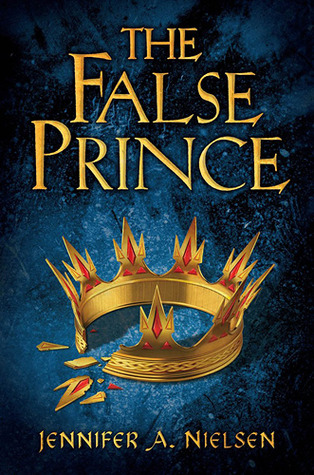
Simple but elegant: the rich, textured cobalt-teal background offsets the understated title font perfectly. As well, the subtle significance of the broken crown fits the quiet atmosphere of the cover.

The book:

The False Prince had tonnes of potential. Political intrigue, when properly wielded, can be spun out like spider silk, turning the plot into a mire of delicious deceit. (See Matthew J. Kirby's Icefall for a fabulous example.) However, here we're fed the political background in two or three chunks, a chapter at a time, along with the worldbuilding. It's offputting and also makes the twist quite a bit easier to predict.

Sage is a likeable protagonist. His prickly-meets-sassy attitude results in more than a few humourous exchanges and his thieving-related abilities are thoroughly impressive. However, he lacks constancy in his actions, as do all the characters, in fact. On one page, he'll be strong and firm; on another, he'll decide to go along with the plan, because there doesn't seem to be an easier option.

This inconstant trait in Conner, our leading evil man, makes for a rather less evil antagonist. He shows a variety of emotions -- unfeelingness, passion, vulnerability -- but in the end it's difficult to make heads or tails of how we're supposed to view him as a character.

The pace moves at a good clip, but nothing truly happens in the middle; the novel's action all hinges on the end result. In addition, the dialogue often turns into info-dumps, and there's a marked lack of fluidity in the storytelling. With an uneven gender balance in the characters (Imogen is the only female character, and the only interesting one besides Sage), this middle-grade fantasy is a disappointment for me.

Rating: 2.3 out of 5