Showing posts with label canadian. Show all posts

Monday, 1 July 2013

happy Canada Day! + July absence.

Canada, whoot!

Hello <3 It's Canada Day! I was going to write up a post full of Canuck author-ly goodness, but I'm currently on the road, so instead here you get a PSA.

Posts on Pass the Chiclets will be pre-scheduled for July, and I won't be able to respond to comments in a timely fashion, but I hope you'll still swing by; I have a few things lined up, including a giveaway and a special guest post series. :)

Happy Canada Day, loves!


Friday, 1 March 2013

review: Quicksilver

by R. J. Anderson
Carolrhoda Lab, March 1 2013
young adult sci-fi
e-galley received via NetGalley

Summary:
Tori Beaugrand thought it was over when Sebastian Faraday sent her and Alison back home through the wormhole. But when a genetic company's overeager inquiries into her inexplicable DNA send her family to a new city, a new life, the last person she expects to see again is Sebastian -- and his news inverses her world: the wormhole could still suck her back in at any time, and she could end up back in Mathis's clutches. Again.
The cover:

I'm not sure which scene this is supposed to be, but regardless, the shadowing and lighting contrast will definitely make for one striking cover to match Ultraviolet's. All the text choices (font, treatment and placement) are perfectly adequate as well.

The book:

Quicksilver's pace is sharp and thin, like the edge of a knife: the tension slides ever higher, subtly, smoothly, in such an invisible fashion I want to call this book quiet, as a compliment. It matches the book's (literally) out-of-this-world premise, along with enough twists and kinks to keep you on the edge of your seat. I do have to admit that I lost track of the real problem a few times; plus, the subplot involving Deckard didn't seem fulfilled.

Each character gets ample time to develop their rapport with Tori/Niki. Milo is a clear stand-out (why aren't there real-life boys like him?), but the parents and Alison all have excellent relationship growth with our protagonist. And Tori/Niki is a protagonist who somehow always garners the reader's support, no matter if she's being vulnerable, snipy or paranoid; she calls her parents out on racism and also forces Milo to handle her asexuality with aplomb.

One issue I had was the faceless antagonists. Mathis never once surfaces in person (aside from in one of the four well-inserted flashbacks), thus making the main threat seem very anonymous. This does serve to shade Sebastian's character with 3D ambiguity, though, as the only link to the villain. In addition, the genetics company behind Deckard's investigations never seems a legitimate threat.

All in all, with a Canadian setting (shout-outs to Toronto, Montreal, the Habs and Algonquin Park), chapter titles featuring binary notation, countdowns and engineering terms and a head-spinning concept, Quicksilver is worth your time.

Rating: 3.8 out of 5

Wednesday, 12 December 2012

Waiting on Wednesday

a meme hosted by Jill @ Breaking the Spine
*
The Lives We Lost
by Megan Crewe
Disney/Hyperion, February 12 2013
young adult sci-fi/apocalyptic

Summary (from Goodreads):
A deadly virus has destroyed Kaelyn’s small island community and spread beyond the quarantine. No one is safe. But when Kaelyn finds samples of a vaccine in her father's abandoned lab, she knows there must be someone, somewhere, who can replicate it. As Kaelyn and her friends head to the mainland, they encounter a world beyond recognition. It’s not only the “friendly flu” that’s a killer—there are people who will stop at nothing to get their hands on the vaccine. How much will Kaelyn risk for an unproven cure, when the search could either destroy those she loves or save the human race?
I really enjoyed the first book, The Way We Fall -- Megan Crewe got me to care about the characters with a simple but unique writing style, and I totally want to know whether Kaelyn succeeds. Plus, Gav. <3

Thursday, 29 November 2012

review: The Friday Society

by Adrienne Kress
Dial Books, December 6 2012
young adult steampunk
ARC received from publisher (thank you!)

Summary:
Cora knows how to smooth out her East London accent, handle explosions on a daily basis and build lethal weapons. Nellie can smile her way out of most situations, discombobulate anyone with ruthless cheer and look her best at the same time. Michiko can wield a katana, mock her boss without him even realizing it and follow the samurai way of life... mostly. When serendipity pushes them together onto the tail of a series of murders across the city, you can bet they'll be ready for it.
The cover:

That font and the radiating stripes in the background totally fit the time period. I adore covers with photographs obviously taken for that specific book, and here the three girls fit the story perfectly. Plus in person it's even better, guys. There's a very light film treatment over the colouring that makes it look old-timey but not in a hokey fashion, more like Instagram's Nashville filter.

The book:

The girls carry this story. There's a flair to the third-person, anachronistic narration style that identifies each protagonist; it's this style that somehow distinguishes Cora (sarcastic, pragmatic) from Nellie (frank, cheerful; she's how I imagine a typical American Southerner to be like) from Michiko (dry, focused), and it's all done well. A few quotes to illustrate what I mean:
Lord White had her [Cora] put on the goggles he'd had custom made to fit her tiny ten-year-old frame, handed her the strangest-looking gun she'd ever seen, pointed it in the right direction, and told her to pull the trigger.
Just like that.
So she had. And the dummy's head in front of her had exploded into a million pieces.
"Great aim!" Lord White had laughed enthusiastically for a good five minutes after the destruction.
She had been in love with things exploding ever since.
What she didn't love was green goo.
And failure.
(p. 6)
Cora turned and looked at Nellie, who seemed surprise that the progress of her tying [Cora's corset] had been interrupted.
"Jealous?"
"It's petty. And it's not your fault. I hate seeing other girls get on with Raheem [Nellie's boss]. Especially girls my age. Women are okay, and they make fools of themselves flirtin' with him. But you... he seems to like you. And I don't want him likin' you better than he likes me. He's like a father to me, see."
Cora just stared at Nellie, who seemed perfectly relaxed and amiable.
"That's... honest."
"That's how I am. But don't worry. I know it's not your fault. And I know it's just me being all insecure and everything. I'll get over it. And I like you too much to let it bug me. Now turn around so I can tie you off."
(p. 128)
One of Callum's footmen opened the door slowly and peered around it. Callum [Michiko's boss] only had two, an older man, over sixty, and this one, a boy younger than even she was. Michiko had taken to nicknaming them "Shuu" (dried meat) and "Koukou" (baby chicken). Of course, nobody knew the meanings of the words, they just put up with her calling them that.
(p. 62)
The issue of Michiko speaking little English and thinking in Japanese also is excellently executed (*cough* Jay Kristoff's Stormdancer *cough*):
"Someone is in the alley to see you."
She understood most of the sentence except for "alley".
...
They stepped outside into the alley behind the row of terraced houses. Ah. So "alley" meant alley. Good to know.
(p. 62)
It's heartwarming to see Cora bounce off Nellie's nearly irrepressible cheer, and to watch Michiko decide whether she can dedicate herself to the samurai lifestyle. And the variety of secondary characters is wonderful: Raheem shows that not all older men are insufferable or self-centred; Hayao's bubbly personality allows Michiko's softer side to peek out. Our antagonists aren't as well-developed, but we still get a thoroughly creepy vibe from Dr. Mantis and understand the true antagonist's motive for turning so evil.

As for the potential love interests: Andrew is... an interesting character, and definitely an unusual one, and Cora's reaction to him is authentic and helps to develop her own character at the same time. And the scene in which Nellie and her policeman go on a date is a refreshing departure from the now-common intense lurve-filled dates of YA.

The mystery is pieced together with cute-if-useless policemen, break-and-enters into mansions and investigations in Parliament. Throughout it all, bits of worldbuilding slide neatly into place like puzzle pieces -- Cora provides a commentary of Parliament, Nellie squees over a steam cab and Michiko rolls her eyes as her boss carries on an affair with a client. Action scenes occur in the London Tower (or "Bloody Tower") and in a tunnel used for London foot traffic.

The finish is wonderful, pulling together the best elements of the writing style, the action sequences and the ultimate feel-good interaction between our gals. This is a book I'd reread. I hope most desperately for a sequel.

Rating: 4.5 out of 5


Thursday, 24 May 2012

review: Don't Laugh at Giraffe

by Rebecca Bender
Pajama Press, May 15 2012
picture book anthropomorphism
received from publisher (thank you!)

Summary:
Giraffe and Bird are always bickering. The bird doesn’t miss out on any chance to laugh at the giraffe—and that’s exactly what he does one day as the giraffe attempts to reach the water hole without getting his hooves wet. By the time all the animals join in laughing, the giraffe is well and truly embarrassed. Can the bird make the giraffe feel better?
The cover:

Eesh. The cover illustration isn’t representative of the level of art on the inside (acrylic paint on texturized board, by the way). That gradient going from purple to yellow makes the sky seem like a random background rather than a setting, and the picture’s composition ends up having the bird, the giraffe head and the title fight for your attention.

The book:

This picture book had tonnes of potential. The bright, vibrant art and varied typography makes Don’t Laugh at Giraffe extremely kid-friendly. However, the problems with the text start almost immediately. The first line is: “No one would argue that Giraffe and Bird are an odd pair.” Right off, the author names the animals as Giraffe and Bird, capitalized. But on the next spread and for the rest of the story, the pair is referred to as “the giraffe” and “the bird”. Why? Using the animals’ names as their actual names would’ve made them far more likeable. It’s an appeal factor, just like humans have names.

Next, the diction. One sentence: “When the giraffe senses the bird swoop after him, he scrambles to go faster than his legs will allow.” This line is extraordinarily verbose by picture book standards. On many occasions a simplification or two would make for a much more succinct and readable sentence. But then, in odd contrast, there’s a clean sentence that is picture-book-perfect: “His ears are droopy, his eyes are misty and his nose is sniffly as he laps at the muddy water.” The repetition of noun-to-adjective is excellent technique, and well-emphasized with typography.

Unfortunately, the loquacious issue sticks its head up again with the spacing of the words on each page. On some pages, the text is boxed into a corner or stretched out along the bottom in a way that will cause readers to wonder at which section of the page they should be looking at next. As well, the beginning spends literally 25% of the 32-page book on developing the animals’ relationship, which left me wondering when the book’s actual story would commence.

The theme of the story is ideal; if properly executed, it would’ve subtly achieved its message, and the art’s excellence is clear—Bender’s animals are simple and realistic, yet cartoonishly fun. Don’t Laugh at Giraffe works as a readaloud, but on their own young children will have trouble. (With words like “phlegmy”. o_O)

Rating: 2.4 out of 5

Tuesday, 13 March 2012

review: Under My Skin

by Charles de Lint
Razorbill, March 6, 2012
young adult urban fantasy
ARC received from publisher (thank you!)

Summary:
Josh Saunders never expected to become on of those freaks -- a Wildling, a teen capable of changing into an animal form. But once he's morphed once and back, it's clear he's stepped into an entirely different culture. Confiding in friends Marina and Desmond leads to accidental betrayals, and wildling Elzie's radical ideas are as risky as her good looks. And with the FBI are after them -- or at least a group with as much as the FBI -- it's clear that no matter where they run, trouble will be on their heels.
The cover:

First impression: what the donkey am I supposed to look at? The top half (poorly) mashes together a face and eyes, without any continuity into the bottom half, which admittedly has well-treated font and pretty cool skyline. But when bunched with the abundance of text sprawled across the cover... well. Suffice to say my sensibilities are offended.

The book:

Hmm. (There are times when I am so glad I run a book blog so I can write things like "hmm" in my reviews. Booklist or Kirkus Reviews wouldn't dig that, for sure.) This one was... odd. I'm going to try and break it down.

» The concept. It's nothing new, for sure, but here we get modern shape-shifting backed up by a solid steeping in First Nations folklore. References to the trickster Raven and the Coyote clan add authenticity to the Wildlings, or "cousins". As the characters spout the requisite questions, however -- why are we like this? how can do this? who else can do this? -- we're still left with dozens of questionable aspects ot the concept.

» The characters. Cory, Dillon, Chaingang, Tomas, Auntie Min, Rico, Solena, Elzie... is your head spinning yet? And don't forget the protagonists. We start off in Josh's head, which goes along nice and dandy until Marina's POV comes around. Her mooning puke-on-the-page feelings towards him ("...Josh. My Josh.") paired with the secret she hides hardly make her an appealing friend. Then as characters, one after the other, recite numberous shining qualities re:Josh, I grew more and more turned off by the obvious effort to make Josh the good guy. No. Not buying it.

» The credibility. From the dialogue to the (apparently) violently menacing villain, the credibility level wavers below believable.  Occasional slang phrases that seem off cause winces, while the lack of a single evil face makes it difficult to fear the "bad guy". Altogether, Under My Skin did not make for an enjoyable read.

Rating: 2.1 out of 5

Friday, 9 March 2012

review: The Way We Fall

by Megan Crewe
Disney/Hyperion, January 24, 2012
young adult sci-fi

Summary:
Kaelyn’s back in a town, alone with her only friend Leo far away in NYC, and everything seems more estranged than ever. But her social pariah state become the least of her worries when a virus sets in. It isn’t your ordinary bug. The normal cold symptoms give way to hallucinations and low social inhibitions, and worse, it’s spreading—and leaving death in its wake. As the government quarantines the island and rebellious feelings grow, even the best resources in the hospital won’t be enough.
The cover:

We seriously need more colours in yellow. I’m a big fan of solid colours and type masks together, and though the image behind the title is a little too shadowy, this cover still is lovely. Snazzy font, too.

The book:

I went into this extremely curious. Megan Crewe’s debut Give Up the Ghost was paranormal, on the short side and pretty darn wonderful. The Way We Fall, on the other hand, is sci-fi (ish?), 300+ pages and…potentially wonderful. Well, now I can say for sure it is wonderful.

Kaelyn’s introduction is perfect. Though it’s her writing letters to Leo in a journal, we see enough of her own actions through what she writes to like her right off the bat: her efforts to become a “new Kaelyn” and work through her tumultuous history of moving about endear her to us with ease.

The concept of family structure is explored subtly (unintentionally?) through characters like Meredith, Kaelyn’s realistically portrayed younger cousin, and Tessa, Leo’s girlfriend. The latter plays a surprisingly prominent role in Kaelyn’s survival plans, and even in Kaelyn’s character development.

And Gav. I’m giving this guy a paragraph to himself because his full name is… I won’t give it away, so you can have the pleasure of discovering it yourself, but my God. If a name can be swoonworthy, Gav’s is. Oh yeah, and he’s a pretty cool love interest too—nobleness is underrated. ;)

Usually, letter or journal style I hate. (Dear Canada and Love, Stargirl were the banes of my elementary English class days.) Yet somehow Crewe mashes the two and make them work in a way that is far more engaging than weird. It’s almost as if Kaelyn is speaking to herself, and the mix of present and past tense is handled deftly as well.

It’s enough to keep you reading through the plot, which isn’t breakneck—it’s more of a bell curve. And that, combined with all the other elements, was enough to keep me reading until I’d finished this in one day. And man, that ending. Not precisely cliffhanger in the “WTF? I can’t believe this” sense; more like “Whoaaaa. What’ll happen next?”

Good things, mes amies. Good things.

Rating: 4.4 out of 5


Friday, 10 February 2012

review: My Beating Teenage Heart

by C K Kelly Martin
Random House BFYR, September 2011
contemporary young adult

Summary:
Ashlyn is suspended—metaphorically and literally. She has no substance; she’s attached to a boy named Breckon Cody with no memories of her own, watching as this boy falls to pieces, watching as he destroys the life she longs to regain for reasons more serious than anyone could know… reasons as dire as the cause of her own death.
The cover:

The font—oh, I dig it. The red is a lovely contrast against the image’s neutral grayness, and of course the hand-formed heart is a picturesque representation of the title and book. However, it would’ve been nice if the body were a little more distinct. Otherwise, it looks like a smog of nothingness with arms coming from nowhere.

The book:

If I were to describe the atmosphere, tone and mood of this book in one colour, it would be gray. With plenty of time spent in introspection, flashbacks and ponderings in general, this books is nowhere near suffused with colour. That doesn’t make it bad; in fact, one could say the navel-gazing is necessary, as it provides the only counterbalance against the waves of negativity Breckon seems to produce automatically with his actions.

Ah, Breckon. It’s not hard to see where he’s coming from, as guilt is one of the most common emotions experienced after a tragedy of any sort. His decisions are therefore made slightly more palatable, but only to the extent that the reader will tolerate him, never truly rooting for him as a hero. Ashlyn is a much lovelier gal to hang out with as she tries to navigate Breckon onto better roads. However, her chronicle is almost more depressing than his. The injustice of her death keeps the story from being fully satisfying, leaving a saddened, helpless feeling behind.

The mechanics of Ashlyn’s caught-between-life-and-death floatation powers aren’t fully explained, something to be expected from this novel classified as contemporary. However, while we might be willing to accept Ashlyn’s existence, another character’s floatational (okay, that’s not a word) entry is just plain boggling. Not to mention it makes the ending that much cheesier. But My Beating Teenage Heart is pretty enough in its soul-searching and meditation aspects to warrant a read. With its shorter length, it won’t be a waste of time.

Rating: 3.3 out of 5

Tuesday, 31 January 2012

review: Darkest Light

by Hiromi Goto
Razorbill, January 31, 2012
young adult fantasy
ARC received from publisher (thank you!)

Summary:
Gee knows he’s not the same as his peers. He looks nothing like anyone else—and as far as he knows, nobody else has swells of dark emotion that urge him to act evilly. When Gee’s past in Half World is revealed to him, he thinks it could be his chance to find his parents, find his past. Barely staying out of monsters’ arms, Gee ventures into Half World with a sulky cat and an unstable Goth girl named Cracker, where it will be up to him to fall back into the vicious Half Life cycle… or break out of the vicious circle and prove his humanity.
The cover:

The illustration style is so, so lovely, but I have to say that I really dislike the pose they’ve captured Gee in. I’m partial to active covers, and this could’ve been such an awesome one, especially with the eel in the mix. But yeah. :/

The book:

With both a prologue and an introduction, the first chapter’s frontloaded backstory—however succinct—bogs the reader even further down. Add to that the fact that Gee isn’t the most likeable hero, and we have a slow start to this sequel to Half World (Razorbill, 2010). Of course, there is a reason why Gee isn’t likeable. His struggles with his inner self are realistic, but also prevent any kind of smooth character development; the instant that Gee starts feeling more human, his evil voice will speak up, or vice versa, and they’ll be back at square one.

Cracker, the Goth girl, is spastic, prone to mood swings and occasionally irrational. The only thing that makes her identifiable as a Goth is her attire. Thus Cracker is not a stereotype, but she also doesn’t seem like a real person. The emotion that leaks through in Half World thanks to her sister’s death goes a ways to making her seem genuine, but it’s only when she shows her guts against Gee in the climax that we start to like her. White Cat is, unfortunately, a stereotype—the condescending animal companion who only has advice to sling around in the form of insults. However, he provides excellent and timely comic relief when not playing his role.

The plot moves smoothly, thank goodness. A few bends and kinks illustrate the depth of Hiromi Goto’s creative Half World, but not so many as to tire us with the amount of misery. The suffering in the story balances neatly with the theme of redemption. It’s the ending where Goto’s writing shines best, flowery-eloquent. Her ability to write an Oriental language as English is also excellent; Ming Wei’s maternal speeches are Chinese if I ever heard it before: “And no more swearing! Wahhhh! Such a mouth on this one! …She has too much heat. Yin deficiency. She needs a soup. And lessons in manners.”

Rating: 2.9 out of 5

Wednesday, 19 October 2011

review: Love is a Four-Letter Word

by Vikki VanSickle
Scholastic, September 2011
contemporary middle-grade
received from publisher (thank you!)

Summary:
Love is in the air, at least for everyone Clarissa knows. Her mother spends all her time with Doug, her personal trainer, and her friend Mattie is collecting new boys to crush on like candy. Then there's Michael Greenblat, who might be interested in Clarissa in a more-than-friends way. With her best friend Benji always busy with theatre, Clarissa will have to figure out how the factor of like and love will shift all aspects of her life.
The cover:

I actually didn't dig the previous novel's cover, but putting these two together, they look a lovely ensemble. This does kind of remind me of a YA cover, This Girl Is Different by J J Johnson. Good thing the colour and typography schemes are unique enough to differentiate.

The book.

Oh, MG. <3 I'm pretty sure the highest compliment I can give a middle-grade novel is that it made me want to relive middle school over again, and Love is a Four-Letter Word did. The birthday party at an Asian restaurant, the auditioning for the local theatre, even the cluelessness with which Mattie picked her crushes all are middle school incarnate.

Then there's Clarissa, who's retained her delightful sass and sense of righteousness to make for dozens of hilarious situations that spur the storyline forward almost effortlessly. The encounters involving her and her mother's new boyfriend, the jealousy she feels towards Benji getting into the play without her and the confusion around her relationship with Michael are all so real and down-to-earth that you can't help but say, "This IS how it is."

Though the plot does coast along at a fairly snappy pace, it isn't anything spectacularly original. In the end, Love is a Four-Letter Word is a novel that relates just how a fourteen-year-old girl in the middle of the biggest transition of her life feels.

Rating: 3.9 out of 5

Monday, 10 October 2011

review: Plain Kate

by Erin Bow
Arthur A. Levine Books, 2010
young adult fantasy

Summary:
Plain Kate is a wood-carver's daughter and an orphan. An abnormal, lethal fog is spreading across the countryside, and with Kate's skill at the blade, the townspeople have started to point fingers her way. When a witch-white stranger named Linay offers her escape and her heart's wish in exchange for her shadow. Kate accepts, and so launches her journey to carve out a life of her own and save a city from one man's mad grief and love.
The cover:

I just say it over and over these days: illustrated covers rock. The warm yellow paired with the light green is a welcome shift from the orange-blue contrast designers adore, and the intricate detail in the illustration of the city is pure loveliness.

The book:

I'm still sniffing as I write this. :') Erin Bow has created a medieval land that is full of luck and superstition, magic and curses, but no less human for it. The lives of the Roamers (think of them like Gypsies) add an extra layer of depth to the world.

From the first chapter, Bow's eloquent writing enthralls. I'll quote for you rather than try to explain:
The cat looked up at her with the last trace of his broken heart, and then turned to look at the gold coins with simple gold-coin eyes. (p.310)

She was made of fog and shadow until Kate caught her eye, and then, all at once, she became human. She was young, mischievously sad, a fox in a story. (p. 199)

And Taggle, who was beautiful, who had never misjudged a jump in his life, leapt toward her with his forelegs out-flung. (p. 289)
Is that not pure beauty?

Plain Kate finds her way into the reader's confidence just as the prose brings the reader to their knees by the second page. Her grittiness and down-to-earth perspective makes her someone who we're sure will persevere. Especially with Taggle, the cat who talks, by her side. Oh, Taggle. I solemnly swear upon the tears he brought that he will steal your heart and break it. Into a bazillion pieces. <3

Even Linay, crazed person extraordinaire, will get you on his side. The sorrow and grief he transofrms into revenge and madness can be solidified in his "heartbroken, startled laugh she'd tricked from him once or twice before" (p. 285), and: "On the paper, in a hand so fierce it threatened to topple and break like a wave, Linay had written: Kate. I hope you live." (p. 310) *sniffs*

This is ultimately a tale of death and living and sorrow set in a storyworld that somehow ends up meaning so much more than any contemporary novel set around grief that I've read.

Rating: 4.5 out of 5

Friday, 7 October 2011

review: Give Up The Ghost

by Megan Crewe
Henry Holt, 2009
young adult paranormal

Summary:
Ever since her best friend turned the whole school against her, Cass McKenna's pretty much only had ghosts for friends. Which suits her just fine, since ghosts always have the best dirt for her to expose the poseurs at her school. She never expected Tim, student council VP, to figure out her secret -- or ask her to use it to contact his dead mother. When Cass agrees, neither of them suspect just how severe the consequences will be for Tim, and in turn how changing her entwining in his life will be for Cass.
The cover:

Looooove it. Look at all those warm, lingering shades of blue, and the way the perfectly normal (and brunette!) girl is contrasted by the faded hand of a ghost. It represents the situation perfectly, really. A wicked awesome title font combination rounds off this absolutely A++ cover.

The book:

Give Up The Ghost ended up darker in content than I'd thought it'd be -- consider it, tone-wise, similar to The Ghost and the Goth by Stacey Kade. Basically, less romance, more character growth and "issues", and a sore lack of founding for all the paranormal activity. It didn't read as expected, but definitely didn't end up worse for wear. Far from it.

Cass is awesome: smart, prickly and flawed, but not in a way that makes you want to punch her idiotic lights out. And she's hilarious, too -- just a sample of her wry, dry wit that makes this entire novel a delight:
The guy chases me around the city all week, and now that I actually want to do something for him, I've got cooties. Perfect.
Watching Cass realize, work with and overcome her own social roadblocks feels like a personal accomplishment. She's a normal kid, you know? Albeit with ghost-interacting abilities. She's just trying to face the injustices thrown at her long ago.

Crewe handled the age-old parent's-death tactic realistically, offering a chilling view into the world of the grieving. Watching Tim change as a character is at least as interesting as Cass is heartwarming, if a touch morbid at times. And the pure loveliness of their almost-more-than-friends relationship at the novel's end is gorgeous. So feel-good. *sigh* :)

The grim perspective that all their friends are in it for themselves is never quite resolved (are they, or are they not?), and backstory for Cass's paranormal abilities is skimpy. This novel isn't without its minor drawbacks, but in the end it's one you should read just to experience the most touching and real relationship a teen girl and boy can experience. Or I can give it to you this way: Give Up the Ghost was good enough to make me buy it. :)

Rating: 4.3 out of 5

Wednesday, 5 October 2011

review: Llama Llama Home With Mama

by Anna Dewdney
Viking 2011
anthromorphism picture book
received from publisher (thank you!)

Summary:
Llama Llama wakes up feeling under the weather. But staying home isn't fun for this young llama: his toys are too boring, the medicine is yucky. And when Mama starts sneezing too, the tissues really fly. Can Llama Llama and his mama turn this day around?
The cover:

These full-scene covers are always the best choices; the variety of colours catch the eye and acquaint the reader instantly with the illustration style.

The book:

This is the kind of picture book that makes every aspiring picture book author want to rhyme, in hopes of getting their opus magnus as readable as Llama Llama Home With Mama (man, it's way too difficult to type "llama"). While the meter isn't perfect -- I'm not sure there's any rhyme pattern out there that fits "medicine" -- it's bouncy and as imaginative as the simple vocabulary allows.

Dewdney takes her time setting up the sick, bored atmosphere in the first third of the book with whimsical illustrations alongside. Choice scenes are drawn fully, the paper's texture coming through the bold colours for a quirky added effect. The neat twist and shift of the plot perks up the reader and injects an "aww" factor that always makes a picture book a winner.

Parents and kids will recognize and identify with the reversed situation with humour. The scope of this picture book is narrow, but it satisfies with its bright illustrations, smooth rhyme and familiar topic.

Rating: 3.5 out of 5

Thursday, 21 July 2011

review: Ultraviolet

by R. J. Anderson
Carolrhoda Lab, September 1, 2011
young adult sci-fi
e-galley received via NetGalley

Summary:
Alison wakes up in a hospital to the news that she's confessed to killing Victoria Beauregard. Thanks to her "episode" that led to her hospitalization, Alison's now committed to a psychotic ward in northern Ontario. Convincing her parents and doctors she's not crazy is hard while she's trying to figure out exactly what happened to Tori, what her synesthesia has to do with her abnormal powers and how her new psychiatrist's eyes could possibly be ultraviolet...
The cover:

It's not flat-out gorgeous, but all that violet totally lives up to the title. The various nuances in the hues and all the shadows make for an appealing eyefeast, and OMG. That tagline.

The book:

This was the weirdest mash of sci-fi and paranormal. The blurb said "genre-bending", but I wouldn't exactly call it that; it's more like the various elements were almost the same, but didn't mesh perfectly. It actually didn't detract from the novel, though, because you could tell it was very ambitious, so you just went along with it.

The first half of Ultraviolet is somewhat predictable: protag wakes up in hospital, gets committed to crazy ward, spends a third of time trying to get out. It's a good thing that the murder of Victoria throws things for a loop. The clash of Alison's memories with what the world tells her makes for a good atmosphere in the ward, and the friends and not-so-friends she makes also help the time she spends there realistic, and not too bleak in the "pity-me-I'm-stuck-here-without-anyone-on-my-side" way.

When the technology and real sci-fi aspects of the novel kick in, the out-of-this-worldness (literally) may throw some readers for a loop who haven't been expecting such hard-and-fast science, though Alison's synesthesia and subtle powers do set up the stage. The romance is deep, almost lush, and I'd call it intense -- but not in the way where 16-year-olds find their soul mate. It's a mature romance, which is unusual for YA but a wonderful change. It also helps the reader get more connected with Alison, since previously she's focused on getting out of the ward and obsessing over Tori's death.

Watch out for the ending -- it's bittersweet, and if you enjoy the all's-well-that-ends-well kind of story... I still think you should read this. It's thought-provoking and a refreshing deviation from all the paranormal out there.

Rating: 4 out of 5

Tuesday, 5 July 2011

review: Zorgamazoo


by Robert Paul Weston
Razorbill, 2008
middle-grade fantasy

Summary (okay, so maybe my rhyming meter sucks):
Here is a story that's stranger than strange
but don't think you're crazy or slightly deranged!
The tale of a girl named Katrina Katrelll,
Morty the zorgle tagging along as well.
They're on an adventure, a veritable quest
to save dragons, the griffins, the trolls and the rest
from an extinction too awful to bear.
How can they escape from the breadth of a hair?
The cover:

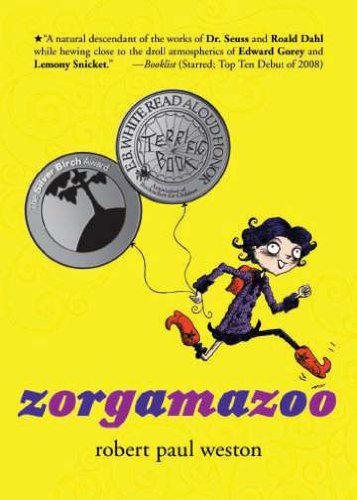
Look! Balloons! But the balloons are actually the awards this book has won! Now that's awesome designing. The crunchy font of the title is fun too, and I love the red cowboy boots.

The book:

Zorgamazoo is written entirely. in. rhyme. Which makes it impossible not to read aloud. Seriously, you'll read the first two lines and be compelled to say them out loud. The meter is solid the whole way through, too, and the vocabulary is unusually lush and expressive.

Characters and plot don't suffer because of the rhyme, either. katrina is a brave heroine who has her tantrum-y moments. Morty never wanted to be a hero, but he learns in his own timid yet appealing way that being a hero comes in many different ways. A truly fantastical storyline keeps readers captive with Enchantium gas, a scarily boring alien planet named Graybalon-Four and on Doctor LeFang armed with  a "Cranial Puncturing Mincer of Mind". There isn't a lack for touching scenes, either; Weston cleverly turns a death into an occasion to celebrate:
Don't worry, my reader. No need to be sad. / A death isn't always entirely bad. / Among zorgles, for instance, a life that is long / is a life best remembered with dancing and song. (272)
Oh, and you cannot overlook the illustrations and design. Victor Rivas Villa has the most adorable detailed illustrations of Katrina, Morty and many other characters, and Christian Fuenfhausen, miracle book designer that he is, uses a wondrous variety of fonts. They're so awesome it's mindboggling:


Rating: 4.5 out of 5

Monday, 20 June 2011

review: Sinking Deeper, or My Questionable Decision to Invent a Sea Monster

by Steve Vernon
Nimbus Publishing, 2011
contemporary young adult
review copy received from publisher (thank you!)

Summary:
It wasn't even fourteen-year-old Roland MacTavish's idea to saw down the neighbour's clothesline pole and use it as a caber. No, that was all his Granddad Angus's idea, but Roland's the one who's getting shipped off to Ottawa, since according to his mom Deeper Harbour is a dying town. So Roland figures out a way to re-invigorate the community and bring the tourists back: he'll invent a sea monster. Soon Granddad Angus, Roland's friend Dulsie and Dulsie's father Warren are onboard, and they set into motion what might be not only Roland's liberation from Ottawa, but also a sleepy fishing town's renaissance.
The cover:

Love the drawn monster and the handwriting below the "Sinking Deeper". One thing that sticks out is that the photo of the village seem to have been taken at night, which I don't like. Just a little detail.

The book:

The author nails the voice of a fourteen-year-old boy. Nails it, just about drives it through the pages. Roland's at times cocky, impulsive and prejudiced and at times wary, nervous and downright scared. Other characters aren't lacking in dimension either: Dulsie is a self-proclaimed "punk-goth-freakazoid" with a new tattoo every day; Granddad Angus says adventure is just a long-winded way of saying fun; and Warren, Dulsie's father, turns out to have hidden depths -- maybe a little too many to stay realistic.

This kind of "wild plan" novel stands out from other teen scheme books in that the plan doesn't backfire. Instead, the author uses it to subtly deepen Roland's understanding of his community while bringing all kinds of hilarious conflicts into play. The touching ending may be regarded as one that doesn't quite fit with the rest of the novel's tone, however.

Sinking Deeper is divided into five unnecessary parts, seeing how short it is, and the chapters are brief as well. But wait -- David Suzuki almost gets murdered by a caber at the end! Who am I to argue with that? :P

Rating: 3.8 out of 5

Tuesday, 14 June 2011

review: His Sweet Favour

by Diane Tucker
Thistledown Press, 2009
contemporary young adult
review copy received from publisher (thank you!)

Summary:
Favour Wyatt's in her final year of high school, and she and her friends Maryruth, Brady, Rick and Leith already have a plan to start their own theatre company. But the foundations of their friendship are shaken from the very start of grade twelve: first, Leith announces he's been delivered a message by mysterious lights. Then Favour kisses Leith and doesn't hate it, much to his joy, and they begin dating seriously. And soon, Brady, Maryruth and Leith are involved in something almost cultlike, while Rick's developing empathic powers. Favour will have to figure out what to believe, and just what and who she is, to make it through.
The cover:

The whirling blond hair is very cool, and the title font and colouring is done well. What I don't get is the background. It kind of relates to the novel, but not really at the same time. I think my main issue with it is that it give enough a hint of the story.

The book:

I'd almost call His Sweet Favour an "issue book"; it touches upon several issues, but they're not the focus. It's Favour who the spotlight is on. She goes through a tumultuous year and her views on the world are changed several times, and as she goes through all this she grows strong. You just want to cheer her along when she acts to liberate herself.

That being said, none of the other characters come remotely close to Favour's likeability. Not cruel, domineering Brady, not limp Maryruth, not religiously obsessive Leith, not even the too-late-developed-to-like Rick. The adult characters are insanely abnormal to fit in. That's this book's biggest problem -- there are too many problems. It's just too hard to believe that anything involving a bipolar relationship, a mindreading cult and certain unexplained powers all in one novel.

His Sweet Favour is an intriguing journey of a girl at its best, but far too unrealistic and, though it does have some good imagery going for it, especially in the prologue, just plain weird.

Rating: 2.1 out of 5

Tuesday, 7 June 2011

review: Torn From Troy

by Patrick Bowman
Ronsdale Press, 2011
historical young adult
review copy received from publisher (thank you!)

Summary:
After a day of celebrating Greece's retreat from Troy's walls, Alexi wakes up to find his city on fire. Somehow, the Greeks have entered Troy, and before he knows it, his sister is wounded, left for dead and Alexi himself captured and put to work under Odysseus himself. As the Greeks sail homeward, encounters with mythical creatures like the Lotus-Eaters and a cyclops put the soldiers and slaves through dangers and risks. Alexi grows to respect the Greeks, but his attention is immediately drawn when he receives the news that his sister might be alive.
The cover:

I like to see a well-drawn cover now and then, and this one captures the hurried atmosphere wonderfully. The juxtaposition of such natural colours and a unique title font finishes it off nicely, though I do wish the author name wasn't written in Times New Roman.

The book:

This may be written from a Trojan's point of view, but it doesn't make the adventure more original. That summary (which I wrote) doesn't end with a decision or call to action like usual blurbs, which reflects the plot's arc accurately; in the book the tension actually peeters out towards the end, with the action to be continued in the next book. This may or may not achieve the intended effect -- to keep readers waiting for the sequel -- given the writing's mediocre quality.

While the plot doesn't shine, Bowman does take the time to develop his cast of characters. Odysseus, or Lopex as he's known to his men, is equally brutal, cunning and fair, though right hand man Ury is a little too thoroughly evil. Kassander, a slave captured alongside Alexi, has secrets about his origins and past that weave conflict effectively into the story.

Bowman's borrowed action is faultlessly straightforward, to the point where it's nearly predictable. An simple adventure, Torn From Troy would probably go over best with the tween age group.

Rating: 2 out of 5

Saturday, 28 May 2011

review: The Vampire Stalker

by Allison van Diepen
Scholastic Press, June 2011
young adult paranormal
ARC received from publisher (thank you!)

Summary:
Amy may be a big fan of the popular series Otherworld, but she isn't prepared for its characters to spring into life. Handsome, brusque Alexander Banks, the vampire hunter and hero, follows Vigo Skaar, the vampire, right off the pages and into Amy's world. Before she knows it, Chicago turns into a vampire's playground and Alexander's bunking over at her place. Once Amy shows him the books he stars in, they realize that the author Elizabeth Howard may also be in danger from Vigo for revealing the vampire's secrets. Now, it's a matter of taking down Vigo before he turns modern Chicago into another Otherworld.
The cover:

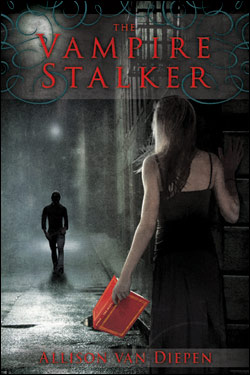
Black and red is pretty basic, but it evokes a mood fitting to the story. Aside from the girl and the book, though, a little more detail with the night and the man (who is he?) would've made for a more developed cover. The font is also a little too standard, but the interior chapter design is lovely.

The book:

The Vampire Stalker is pleasant mainly because its focus isn't the supernatural, it's the characters-coming-to-life part, which is straight-up fantasy, not paranormal. *takes a moment to hug the neglected YA fantasy market* Anyway, it makes this feel a little more unique.

The thing is: this book is extremely straight-forward. Events happen in such a clockwork fashion -- tick, tock, one after the other. Oh, Elizabeth Howard might get threatened? She gets threatened. Oh, little sister goes out pas curfew? She gets kidnapped. The surprises weren't surprising, because they happened just when nothing was happening and something was BOUND to happen. But somehow, the straightforwardness doesn’t detract from the story. It ensures the spacing is consistently moving at a quick clip, though it does mean the most of the novel’s atmosphere is constantly strained.

The juxtaposition of vampires and modern life helps to highlight the danger, but also results in Amy’s school life, friends and family seeming too normal. There’s nothing remarkable about either of Amy’s friends, even as van Diepen tries to distinguish them with things like height and boyfriends. The help Amy and Alexander receive from a librarian only diminishes the importance of the protag, making Amy seem unassertive even as she pulls out the “I feel useless hiding, let me help” argument.

Stretching out the climax with the purpose of ending things neatly leaves the action hanging, feeling unfinished. “Literary physics” is an interesting idea to explain the author’s writing about the Otherworld, but the concept ironically seems too far-fetched when compared to fantastical things like portals and vampires. If such fantasy exists, why use such a mundane notion? Why not just make the author tap in psychically to the other world?

The Vampire Stalker is a different brand of paranormal, but it doesn’t mean the romance or writing is any better.

Rating: 2.6 out of 5


Tuesday, 24 May 2011

review: Ashes, Ashes

by Jo Treggiari
Scholastic Press, June 2011
post-apocalyptic young adult
ARC received from publisher (thank you!)

Summary:
Floods have knocked over NYC's skyscrapers and a plague has killed just about everyone in the world, but not Lucy. Now she's in the wilderness all by hersel -- except for Aidan, the boy who saves her from wild dogs, and his motley crew of young'uns and old'uns. After a tsunami swamps her campground, Lucy reluctantly heads over to the camp. But when Sweepers invade and snatch away important members of the camp, it's clear that someone wants Lucy... or at least her blood.
The cover:

The models look airbrushed, what with the gleam of their clothes and skin. Luckily, the scene they're facing brings back all the "wow" factor every cover needs. The vibe that the fallen buildings and flooding waters give off can be summed up in one word: COOL.

The book:

Just flipping through the first chapter, you see blocks upon blocks of text. Surprisingly, it's not dense to read through. Backstory is woven in and manages to stay interesting. Descriptions of survival actions ground the story in the wilderness and paint Lucy as one tough cookie, while the backflashes show her as an outcast socially. Whether this endears her to or repels her from the reader will be up to you.

The almost love triangle may take some attention away from the plot, but at least it's a girl-girl-boy triangle. The author also wisely saves the melt-your-pants-off romantic scene after the plot climax. Re: the plot: the reason as to why Lucy is so wanted doesn't seem very important or original, it's more like a mash of assorted sci-fi premises. The antagonist also seems small-scale -- with these kinds of epic post-apocalyptics, you expect at the minimum a rampant evil organization.

Action is abundant, as long as you don't mind yours a rehashed version reminiscent of the end scene in Scott Westerfeld's Uglies. The chant "Ring around the roses / A pocket full of posies / Ashes, ashes / We all fall down" doesn't ring as true for Ashes, Ashes (thanks to the lack of emphasis placed on the plague) as it does for Eric Walters's We All Fall Down (an excellent book, one I recommend).

With passable, average writing, Ashes, Ashes is an enjoyable, though not very deep, read.

Rating: 3 out of 5