Showing posts with label young adult. Show all posts

Friday, 8 August 2014

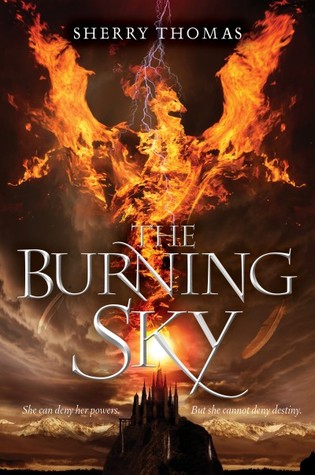
review: The Burning Sky

by Sherry Thomas
Balzer + Bray, September 17 2013
young adult fantasy

Summary:
Iolanthe is the great elemental mage destined to take down the Bane... well, that's according to Prince Titus, who takes destiny very seriously. Iolanthe isn't as willing to sacrifice her life for a fate she isn't sure she can accomplish. But the Bane and his Inquisitor are looking for Iolanthe, too, and to save herself, she might just have to save the world.
The cover:

It's a little too bland. A capitalized, grandiose serif font, a dark sky background with a generic castle and an obscure motif... it almost looks like an adult fantasy rather than YA. I also don't feel it conveys the book's tone very well, but then again it's so generic that it couldn't really convey any tone in particular.

The book:

The Burning Sky is made of some of fantasy's best tried-and-true ingredients: from-the-ground-up magical world-building, a large-scale conflict between good and evil and a look into the idea of destiny and fate. Add in a straightforward, earnest romance, and you've got a book that can appeal to most everyone.

The narrative was written from both Iolanthe's and Titus's perspectives, and it's difficult to decide which one I was more eager to read as the story progressed. Their journies and roles, though physically proximate, follow quite different paths; they're not exactly foils, but different in that Titus is initially very exterior-goal-oriented, and Iolanthe is more focused on her own wants and needs. As such, the dynamic between them helps propel the story as much as the actual plot itself and helps develop the two using backstory, banter and moments filled with humour and tenderness alike.

The overall storyline crests, peaks and dips sufficiently to keep the pace tense. Occasionally, time passes in ungainly, unbalanced ways which leaves the reader unsure where in the story they are, a symptom of books that happen over long expanses of time. One definite highlight is how well-balanced the romance and the plot are — they build side-by-side, but one never overwhelms the other. It's worth mentioning, too, that the romantic dynaic between Iolanthe and Titus is far from conventional, which makes for all kinds of fun to read.

This is probably a side effect of the copious amounts of worldbuilding in this novel: Thomas has created a parallel world to historical London with a history of magic that lends it credulence. With ample time spent both in London and the mage world, there's plenty of opportunity to reveal knowledge about magic to the reader. Concepts like vaulting, magic carpets and subtle vs. elemental magic are explored, and different locales are utilized well and filled with secondary characters.

The theme of destiny is touched upon along with the concept of good versus evil; Iolanthe explores to some extent whether she should work with Titus just because he claims it is their fate. This exploration feels a bit stalled, however, as plot gradually takes over the story. Somehow, by the time the climax comes around, the decision to fight the Bane is a no-brainer to Iolanthe, which makes logical sense but feels a bit off. Nevertheless, the final battle is suitably epic, taking place in an almost meta-level piece of magic.

The fast pace, above-par worldbuilding and three-dimensional protagonist duo make The Burning Sky a fun and intriguing read. Oh — and did I mention that Iolanthe cross-dresses and poses as a boy at Eton for a large part of thebook? Yeah, it's worth reading the book just for that. :D

Ethnic balance: 3 out of 5. Kashkari, a (swoonworthy) classmate at Eton, is Indian, and talks about England's colonization of India in a way that makes me hope it becomes a hot topic in the sequel (The Perilous Sea).

Rating: 3.9 out of 5

Wednesday, 6 August 2014

review: Chasing Shadows

by Swati Avasthi; graphics by Craig Phillips
Knopf BFYR, September 24 2013
young adult contemporary thriller

Summary (from Goodreads, b/c it's stellar):
Before: Corey, Holly, and Savitri are one unit—fast, strong, inseparable. Together they turn Chicago concrete and asphalt into a freerunner’s jungle gym, ricocheting off walls, scaling buildings, leaping from rooftop to rooftop.
But acting like a superhero doesn’t make you bulletproof...
After: Holly and Savitri are coming unglued. Holly says she's chasing Corey's killer, chasing revenge. Savitri fears Holly's just running wild—and leaving her behind. Friends should stand by each other in times of crisis. But can you hold on too tight? Too long?
The cover:

The overlay of illustrated graphic on top of the photograph of the girl's face is a wee bit messy, but excellent in that it combines the best aspects of both: the face avoids being nondescript and boring but conveys tone (look at her expression!) and mystery, and the illustration hints at the graphic content and the, well, actual content, freerunning. There's even colour, thanks to the girl's red hair, and the fonts are nice and discreet.

The book:

I read and adored Swati Avasthi's first book, Split, based off of Audrey's recommendation, and so was very excited for this one. Plus, it has sections of graphics, like mini comic strips, which I thought was a wonderful (and brave) decision on the part of the publisher! But I'd seen some mixed reviews, so I went into Chasing Shadows with my expectations mostly tempered.

Chasing Shadows is about the friendship between Holly and Savitri and the people they are, together and apart. Thus, it's good that both girls are well-developed. Chapters alternate between their first-person narrations, and both voices are very unique; Holly uses capital letters that emulate the way she thinks and Savitri makes lists. And once Holly's mental descent begins, things get truly chilling — Avasthi allows her mindset to get murkier and murkier, while Savitri's confusion escalates the eerie atmosphere. It's a rare inside look into a mentally ill protagonist's downward slope, although I'm not sure how accurate the representation is.

However, this also has its downside. Even though the pacing isn't exactly slow, the plot feels trajectory-less, like it's all smoke and no fire. Evidently, the focus is supposed to be on Holly's frame of mind, and it succeeds in this part, but the result is that the murder mystery lacks hook or engagement. Though the eventual revealing of the circumstances of Corey's death are appropriately dramatic, the distance there feels like a flat plane, broken up only by the two protagonists' occasional, wearing fights.

The graphics are a boon in balancing the novel, fortunately. Craig Phillips' sleek black and white illustrations are simple and evocative, helping the reader to visualize the images inside Holly's mind as she struggles with Corey's death. This is also a good time to mention the Hindu mythology which Avasthi weaves in (including Savitri's namesake) which both characters use to reflect upon their choices and themselves, and the theme of superheroes/superheroism becomes a contentious topic for Holly as well.

The denouement, like the overal story arc, is straightforward but not too neat at the same time, a realistic end for an ambitious book. Despite its drawbacks, I would recommend anyone giving Chasing Shadows a try: the fresh format and fascinating mix of topics make for one unique novel.

Ethnic balance: 4 out of 5. Savitri's race is relevant in all the right ways.

Rating: 3.4 out of 5

Monday, 21 April 2014

review: She Is Not Invisible

by Marcus Sedgwick
Roaring Book Press, April 22 2014
young adult contemporary
ARC received via publisher (thank you!)

Summary (from Goodreads):
Laureth Peak's father has taught her to look for recurring events, patterns, and numbers--a skill at which she's remarkably talented. Her secret: She is blind. But when her father goes missing, Laureth and her 7-year-old brother Benjamin are thrust into a mystery that takes them to New York City where surviving will take all her skill at spotting the amazing, shocking, and sometimes dangerous connections in a world full of darkness.
The cover:

It has a modern feel to it, due to the three different sans serif fonts used and the sun flare effect used to represent Laureth's blindness. Don't know how effective the overlay of a semi-transparent girl's face on top of a city is, but at least it makes it stand out.

The book:

Oh, now this is the kind of book all YA contemporaries should aspire to be. You wouldn't guess it from the beginning, which is a little rocky; flashbacks spot the first few chapters. But Laureth's disability, her blindness, is evident in her worldview, and the way she interacts with her surroundings and other people is an enlightening experience for abled readers such as myself. It's obviously hard for me to judge how accurate Sedgwick represented the blind way of life, but I would say he managed to make it a part of our protagonist's character without turning this book into an "issue" book. And when you see the challenges Laureth faces, the snubs from sighted people, the miscommunications that are just crushing, it's impossible not to empathize with her.

She Is Not Invisible is somewhat unique in that there are about one or two secondary characters, not including the antagonists who really only show up in the latter third of the book. But Sedgwick makes both of those characters — Laureth's brother, Benjamin, and a boy they meet in NYC, Michael Walker — count. Benjamin is an authentic-to-the-core seven-year-old, complete with a stuffed Raven named Stan, and he becomes incredibly important to the storyline by virtue of the fact that he is so important to Laureth. And then there's Michael. Oh my gosh, when was the last time a YA novel had such an amazing twelve-year-old? He speaks like an adult and yet is somehow stunningly adorable when his soft, happy side peeks out; his characterization is truly excellent.

Which is all a good thing, because the plot is wobbly. The author spends almost the entirety of the book sending Laureth and Benjamin around New York City searching for clues, while being beseiged by coincidences and information relating to their missing father. But though this thematic aspect seems vaguely interesting, enough to keep one reading through all the random notes that somewhat resemble info-dumps, the climax is completely action-oriented — and then the dénouement basically gives up on making this theme into anything meaningful, and hurries the storyline into a neat ending. It's a little bewildering.

Yet somehow, Sedgwick still manages to wrap up his last few pages with lovely, emotions-infused writing that brings every feel-good heartstring you have into tune. It's got something to do with the characters, something to do with the way that a contemporary can get away with having almost no plot but still resonate deeply as long as those characters are genuine. I don't quite understand it myself... but even though objectively the plot is wonky, I still loved reading She Is Not Invisible.

Ethnic balance: 2.5 out of 5. Laureth sort of ducks out of discussing Michael's race by saying that she doesn't "see" race. This is literal, but it would've been nice to examine how Sedgwick subverts the "uneducated black guy" trope in Michael's character by having the other characters reflect on it.

Rating: 4.3 out of 5

Friday, 14 February 2014

review: The Winner's Curse

by Marie Rutkoski
Farrar, Straus & Giroux, March 4 2014
young adult fantasy
ARC received via publisher (thank you!)

Summary:
As a general's daughter in a warmongering nation that enslaves its conquests, Kestrel's piano skills are much less valuable than her tactical ability. But soon the question of whether she'll marry or enter the army — there are no other options — becomes moot when the slave she bought on a whim at an auction turns out to be part of a huge uprising of the Herrani people, who are ready to take back their land.
The cover:

The decadent, vintage pink colour scheme is very nice, but almost everything about this cover is misleading. The clean sans serif font and the dark hardwood floor background make the cover seem more like a memoir of societal balls rather than a high fantasy.

The book:

There was so much hype leading into my reading of this book. On top of that, I was very worried that the slave/master concept would become a token trope used as a shortcut in worldbuilding. (I checked; Marie Rutkoski is a white lady.)

Well, the area I had least to worry about was the writing. There is a simple spareness and mastery of structure which permeates through Rutkoski's writing that follows the less-is-more principle; paragraphs describe action and end unexpectedly, leaving space for the emotions to fill themselves in. On a larger scale, the movement from chapter to chapter keeps us shifting from scene to self-contained scene, wasting no time with transitions and allowing tensions to build high, but not too high.

This writing style is entwined with the narration of Kestrel's, and Arin's to a lesser extent, third-person narration. I seem to compare all really solid third-person POVs to Diana Peterfreund's For Darkness Shows The Stars because they seem so rare nowadays, and this is a compliment to both books (a mutual compliment? Is that a thing?). It automatically cuts down on the amount of angst we experience from both characters' heads while still giving an excellent sense of their wants, wishes and hopes. This also aids the balance of feelings vs. action and the overall pacing, and helps the romance feel organic.

In fact, the pacing is something I've seen other bloggers comment on the most, and it is indeed very good, thanks to the aforementioned writing and passing of time through the chapters. After the turning point midway-through, things slow down since we continue to get mostly Kestrel's POV, and she's not in as active a role as she is in the first half. That brings me to the subject of the slave/master concept.

The best I can tell, Rutkoski avoids making any kind of statement on slavery by making it a non-issue halfway through the book. However, this is disappointing in and of itself; though it's not condoned, it also isn't examined at all, which is problematic in that it becomes something utilized for its sensationality, rather than any kind of meaning. (Why not just have the Herrani a people forced to live in the country or something, rather than dragging a loaded concept like slavery in?) Here, the comparison to For Darkness Shows the Stars hurts The Winner's Curse; FDStS developed the idea of enslaved Reduced people extremely well, and showed that development. However, in The Winner's Curse, the Herrani are somehow enslaved once the Valorians defeat them in battle, and then a few short years later throw off that enslavement thanks to a rebellion like it was nothing. There are few, if any, repercussions for the slavery; it makes me wonder if it will play any role at all in the sequels. One would hope so.

Otherwise, the worldbuilding is satisfactory. The nobility is very standard, but peopled with interesting characters, and the excellent ending hints at the development of a larger world outside of the island (?) which Kestrel and Arin are originally on.  I'm not sure if I'd want to read the next book because of the way their romance is wrapped up in this one, but the political intrigue will most likely be enough to keep readers attached.

Ethnic balance: 2 out of 5. Of course, Kestrel and the Valorians are white, with blond, red and light brown hair. I guess this makes the Herrani black/brown/every single other race?

Rating: 3.9 out of 5

Sunday, 19 January 2014

review: Out of the Easy

by Ruta Sepetys
Philomel Books, February 12 2013
young adult historical

Summary:
Josie needs to get out of New Orleans. She can’t live the rest of her life cleaning the brothel at which her mother works while scraping together a living at a small bookstore. But a murder that implicates those closest around her sparks an investigation that keeps her tied to the French Quarter, and her dreams of East coast college grow more and more distant as her current world weaves its secrets around her.
The cover:

This book is impossible to represent in a cover and I’ve got to say that Penguin made a phenomenal attempt at it. Without resorting to some too-obscure, too-general image, Josie’s trapped sentiments are portrayed effectively, and the colour scheme is absolutely lovely. (Those rich greens!) Font choices are a bit ehhh, but overall an excellent effort.

The book:

Out of the Easy is unlike any book I’ve read in a long time… and I’m not even sure why. I think it’s probably the combination of the time setting, the intensely rich atmosphere and the protagonist, but I couldn’t pin it down to one thing. All I know for sure is that this book is worth reading, regardless of what you take out of it.

My dear friend Audrey said in her review that our main character Josie reminds her of Elliot North, from Diana Peterfreund’s For Darkness Shows The Stars, and I am in full agreement. Both characters are imminently capable, scarily relatable (considering one book is a historical and the other is a post-apocalyptic sci-fi Jane Austen retelling) and as a reader, one simply can’t help but feel for Josie. Her level-headed practicality is conveyed through a good balance of show-not-tell dialogue and less-is-more internal narration. Her weak moments make you want to hug her.

This novel is positively stuffed with secondary characters. While some are less-developed than they could be (Charlotte Lockwell comes to mind), adequate page time is given to major personages in Willie, Cokie (oh, Cokie and his puppy birthday presents, I can’t even) and even Josie’s mother; there’s a remarkable variety in the texture of these characters, and they are what drive the story when the plot gets slow. If you don't come out of this novel adoring every single lady who works at the brothel, then go back and read it again. (No, you don't have to. I don't like to order people around. But DORA. SWEETY. SADIE. <3)

Though I’d never call it slow, exactly; Josie has her hands in multiple pots at once, and watching her castle of dreams and lies escalate is just as captivating, if not more so, as finally resolving the murder. Which is a good thing; the murder investigation's resolution is quite open, and the focus on Josie means loose ends involving other characters are left waggling about. Anyway, just focus on the unmistakeable New Orleans atmosphere of this book that makes reading it truly something of a transporting experience. It’s said that setting can become another character in a novel, and in Out of the Easy it definitely does. From the lazy small-neighbourhood police to Willie’s business connections to the funeral at the end of the book to the cottage which serves to slow down the pace when necessary, this book is enveloped in the air of New Orleans’s French Quarter.

And Ruta Sepetys’s writing does not disappoint. The second last line… I love it so much. This is a different book, one I wish everyone would read. Not because they’d necessarily love it, but because everyone should read something truly unusual, and good, and recognize it, once in a while.

Ethnic balance: 2.5 out of 5. Historically accurate, considering the segregation.

Rating: 4.4 out of 5

Monday, 2 December 2013

review: Roomies

by Tara Altebrando and Sara Zarr
Little, Brown BFYR, December 24 2013
young adult contemporary
ARC received via publisher (thank you!)

Summary:
It's the end of their last high school year, and Elizabeth and Lauren are going to be roomates at Berkeley in California in the fall. The start of their cross-cuntry email exchange coincides with the start of a summer that will be momentous for both.
The cover:

The pink and green work exceedingly well together (they're much softer in real life than this image makes them seem), and the casual line-drawn illustration style will likely have a wide appeal. Safe choice in the sans serif font, too, with the tagline in a contrasting cursive font.

The book:

Roomies is the type of novel that stumps all my efforts to write a professional, at least semi-objective review. This book has all the ingredients for a heartwarming and potentially thoughtful contemporary bildungsroman, but somehow it left me feeling vaguely unsettled and disappointed.

Perhaps it's the very fact that the book contains all the typical ingredients. With two co-authors exchanging very brief, quick chapters, it's difficult to get any sense of style to distinguish the story from a generic YA contemp. The same goes for the voice of our two protagonists, and it's easy to confuse Elizabeth's and Lauren's lives.

On top of the neutral narration, the dual cast ends up flattening the secondary characters until they hover between one- and two-dimensional. Elizabeth's relationship with her mother has a tonne of potential to show growth in both characters, but the limited pagetime in this short novel doesn't allow for both her mother and her best friends to develop. This also means that Elizabeth's and Lauren's new boyfriends seem a little too perfect, with not nearly enough chemistry. Keyon may be a stand-out, though:
Outside, the air cools my face and I try to sort through the last 20 minutes. When Keyon comes out, he asks quietly, "Why say you're okay when you're not okay?" (p.189)
As with most YA contemps, the plot is driven mostly by character interactions and the consequences that derive from them. The pace is brisk as Lauren and Elizabeth jump from character to character, so Roomies doesn't drag, at least. It's also lightly sprinkled with humorous and feel-good moments, perhaps enough to satisfy the casual reader.

But for me, the connection with the characters was never there, never strong enough to overcome the inevtiably differences to make this story relatable. (People surf in New Jersey? White people are really more comfortable dealing with gay people rather than black people in San Francisco? Girls really feel the need to call each other "bitch" after five minutes' acquaintance? Really?)

Anyway, personally, Roomies wasn't a good fit for me. I will reserve judgement before saying "not recommended" to anyone else.

Ethnic balance: 2.5 out of 5. Good job for trying, I guess.

Rating: 2.4 out of 5


Monday, 18 November 2013

review: Curtsies & Conspiracies

by Gail Carriger
Little, Brown and Company, November 5 2013
young adult steampunk
review copy received via publisher (thank you!)

Summary:
Sophronia’s second year at Mademoiselle Geraldine’s Finishing Academy of Young Ladies of Quality is certainly proving why training to be a spy is a very good idea. Not only must their school deal with a sudden influx of boys, their trip to London seems fraught with conspiracies involving new technology, the supernatural and several powerful agents in play. Surviving all that plus society’s courting rituals will take all of Sophronia’s strength, intelligence and wit.
The cover:

The shiny gray-scale filter applied to the model is interesting to say the least, but I can’t decide whether it looks good or not, especially when paired with that strong, plain purple background. The title & author text treatment is something I can definitely get onboard with, though. The simple bevel + elaborate ampersand feels modern but quaint at the same time.

The book:

Probably the most disappointing aspect of Curtsies & Conspiracies is the writing. Gail Carriger is the author of an adult steampunk series and the first book in this series, Etiquette & Espionage, suffered from no such problems (or diminished ones, at any rate). Therefore, the jarring leaps between limited 3rd-person POV and omniscient, the awkward dialogue tags and the telling rather than showing make for an unsatisfactory, bumpy read.

This is especially evident in contrast with the voice. At times, Sophronia’s 3rd-person thoughts add delightful humour and panache in a style perfectly befitting the time period. Then you encounter one of the aforementioned road bumps, and much of the steam leaves your reading experience.

The large cast of characters is used effectively to keep the narrative’s tension taut at all times—sometimes too effectively. While Sophronia’s bevy of girlfriends, love interests and professorly acquaintances add texture and variation in her interactions, there are so many of them that some begin to feel like deus ex machine, only becoming involved when Sophronia needs them.

In addition, the love triangle between Sophronia, Soap and Lord Mercer is established firmly, but it remains to be seen whether any meaningful depth will be attributed to the choice between the two. This, in fact, is symptomatic of another problem: the lack of growth in Sophronia. She struggles overtly with one major decision, but it doesn’t seem to have any impact on her actions or even thought processes, making her seem rather flat.

In regards to the plot, the larger picture is effectively set up for a conclusive resolution in book 3, but at times I found myself simply lost in the muddle of conspiracies Sophronia was ferreting out. Conclusions seem to be jumped to, and connections that seem too obscure are in fact made. The climax is a chaotically fun bright spot at the end of the novel, just like the previous book, that brings to a head all of the various plot threads tangled throughout the book.

Curtsies & Conspiracies retains the distinct steampunk flair that was the trademark of the first book in this series, but problems spot the book from storyline to depth. This novel may be enjoyable if you don’t look too hard, but to follow the plotlines, you’ll have to.

Ethnic balance: 1.5 out of 5. It’s England, so everyone’s white except Soap. And even Sophronia doesn’t call out Lord Mercer on his racial slur against Soap. Sigh.

Rating: 2.6 out of 5

Tuesday, 15 October 2013

review: Reality Boy

by A. S. King
Little, Brown Books For Young Readers, October 22 2013
young adult contemporary
ARC received via publisher (thank you!)

Summary:
Gerald Faust is the Crapper. That's all he's been to the millions of viewers of the TV reality show following his childhood, and it seems like he won't ever be more than the problem child with his parents, either. He's more than that now: he works on his anger issues, he has a part-time job, and he even has a crush on a girl... but it feels like it's all for nothing. It feels like nothing will ever change.
The cover:

The fragmented lines evoke the feel of a TV screen perfectly, and the sharp primary colours are stark and a wee bit unsettling. I'm neutral on the actual model and his expression/colouration, but matched with the colours and lines, this cover is pretty darn representative of the book.

The book:

God, A. S. King is insanely talented. Reality Boy is—if I had to sum it up in one word—intellectual. It's mind-bending and twisted and deep, so dark and yet so illuminating that it renders you breathless, stunned, aching. It's not always comfortable to be in Gerald's head; however, it is always 100% real. This book is so genuine it hurts.

So, Gerald. I expected to dislike him a lot more... but he is truly likeable: in a beautifully cultivated, unique voice, he admits his own foibles clearly to himself, he reflects on the paradigm shifts he goes through and he also has occasional absolute bursts of happiness that endear him entirely to the reader. Seriously, these happy scenes are delightful; they simultaneously make one want to hug him and also contrast the depths of the wrongness of the other aspects of his life.
When I get back from gym class, Deirdre tells me I look even sexier sweaty.
"Jesus, Deirdre," I say. "You're killing me here."
She spins her wheelchair around and smiles her crooked smile. "That's only because you want me and you can't have me," she says.
I smile at her. Then I notice that her right foot is off her footrest, and I reach down to put it on for her.
"While you're down there..." she says as I go to stand.
I turn bright red.
"You made him blush, Deirdre!" Karen says.
"Dude, you're gonna have to wear baggy clothes from now on," Kelly boy says. "These chicks are crazy."
Fletcher says, "Okay, guys. Can we please stop concentrating on Gerald's deltoids for a minute and get back to linear equations?" (p. 57 - 58)
Secondary characters are all shades of ambiguous: Gerald's family is absolutely messed up (one simply desires to give a kick in the head to his mother, father and sister Tasha), his shrink is unreliable, and his love interest is, like himself, far from perfect. In fact, the latter quarter of the book offers scene after scene featuring Gerald and Hannah by themselves, microcosms of the path of an authentic teen relationship. It's far from rainbows and butterflies; Gerald and Hannah have several uncomfortable confrontations in which the treacherous edges of a relationship are exposed. At the same time, they develop lovely motifs that echo through the book and deepen its themes.

Reality Boy is more of a character study than a traditional beginning-middle-end novel, and thus the plot hinges on the interactions of Gerald with other people, and the slow reveal of each episode of his childhood. The movement in this novel is spurred by the shifts and changes in Gerald's mindset, in the way he views the world and himself. As he confronts more and more of his old demons and discovers that the world is more full of shit and more full of possibility than he thought, the novel moves forward with him, to an ending that is heartbreaking and perfect and I think you should just go read this book, now.

Ethnic balance: Hmm, I'm really not sure; the way people are described in Gerald's voice isn't too clear, but I'm just going to go with 2 out of 5.

Rating: 4.6 out of 5

Saturday, 28 September 2013

top five: books to reread for feels

The best books make you feel giddy and light-headed—with joy, despair, angst or swooning, it hardly matters. When you feel genuine emotion while reading, you know you've got a good book in your hands. And lately, I've been feeling out of sorts. So I thought I'd return to some books with guaranteed feel-causing, to help myself feel alive again. This will be an unordered list, because really, who am I to compare feels?

Five Flavors of Dumb by Antony John

I feel pretty confident in saying that this is my favourite YA contemporary of all time. The great portrayal of high school is spiced up with a feel-good, escapist tale of a kick-ass deaf girl whose hilarious narration sweeps me up every time like an old best friend, and whenever I need to feel warm and fuzzy (and swoony) again, FFoD delivers what I want before I even knew I needed it.

The Knife of Never Letting Go by Patrick Ness

Read this one to remind yourself how much bigger the ideas of good and evil, morality and entitlement are than you. Also read this knowing that you will hurt lots, too, and know that if you're me, you will not read the second book for AGES in vehement denial of what happened irrevocably in the first.

Plain Kate by Erin Bow

If you love animals--especially anthropomorphic ones--you will love this book. If you would like to cry your eyes out over beautiful writing & a beautiful death, bring some tissues and we can sit in a circle and do a read-along and sob into each other's shoulders while wishing our hearts out for a sequel, because no book has consistently made me cry like this one.

Openly Straight by Bill Konigsberg

For 100%-guaranteed-or-your-money-back laughs. This book makes me believe in friendship, the everlasting kind, and in the inherent goodness of people, and also in the existence of a Ben of my own. But that last one's not as important. *ahem*

Outcast by Adrienne Kress

Because, I dunno, sometimes the only way to feel like you can feel again is to be torn apart by a truly brutal ending.

Love,

Tuesday, 24 September 2013

review: Steelheart

by Brandon Sanderson
Delacorte Press, September 24 2013
young adult sci-fi/thriller
review copy received via publisher (thank you!)

Summary:
When the star Calamity burst in the sky and gifted humans with superpowers, these Epics took over the United States. David's fathers was one of the early casualties at the start of the reign of the all-powerful Epic named Steelheart. Now, in post-Chicago, David seeks out the Reckoners, a guerilla band of people fighting back against the Epics. As he gets closer and closer to avenging his father, David discovers more and more that no one understands about Epics that could be the key to unlocking their secret.
The cover:

Ehhh, it's pretty typical. Chromey, jagged scenery with chunky typography and a grey-silver colour scheme; it all fits, but it's nothing special.

The book:

Brandon Sanderson's writing credentials are clear in this absolute prodigy of a first book. Steelheart has what a debut couldn't: intricate, layered worldbuilding, a diverse cast of characters and beautiful, beautiful pacing. Seriously. The pacing. Sigh. Okay, let's start being coherent. *ahem*

David is seventeen and relatable; his past is tragic, but his practicality and ambition make hime asy to read about, and his excitement over weapons and self-deprecating congeniality provide hilarious moments. Most notably, his continued failed attempts at metaphors and similes (Sanderson unfortunately mislabels some similes as metaphors O_o):
"Wow," I said. "It's like... a banana farm for guns."
"A banana farm," Megan said flatly.
"Sure. You know, how bananas grow from their trees and hang down and stuff?"
"Knees, you suck at metaphors."
I blushed. An art gallery, I thought. I should have said "like an art gallery for guns." No, wait. If I said it that way, it would mean the gallery was intended for guns to come visit. A gallery of guns, then? (p. 142)
Yeah, that's a simile, but whatever, there are so many fun moments that you don't even mind.

The entire cast of the Reckoners is delightful in their well-roundedness. Each member is fully developed with their own personality; Abraham is probably the most interesting—he's French Canadian, is a POC and has a subtly distinct speaking style to go with his demeanour and outlook on life. Really, it's the interactions between the Reckoners (and David) which both develop them individually and cements their friendships:
"Those are the power cells," Cody said, sounding relieved. "I was half worried there wouldn't be any. Good thing I brought my four-leaf clover on this operation."
"Four-leaf clover?" Megan said with a snort as she fished something out of her pack.
"Sure. From the homeland."
"That's the Irish, Cody, not the Scottish."
"I know," Cody said without missing a beat. "I had to kill an Irish dude to get mine." (p. 208)
Megan, David's love interest, nearly verges on the unlikeable, but this merely contributes to the complexity of her character. She will most likely be the star (though not the protagonist) of the next novel, and Sanderson builds up the layers to her character very adeptly.

Now, the worldbuilding. This is the truly impressive aspect of Steelheart. Not only are the ramifications of the Epics explored, but Sanderson ties the theems of morality andi nherent good & evil into the superpowers: why do all Epics turn evil? What does power to do goodness? Furthermore, he delvces fully into the science regarding the Epics' ability; David's nerdy Epic classification is a thing of beauty as he breaks down photon-manipulators versus mental illusionists, and wonders how Epics' mitochondria can be used to create powerful new technology. Probably the thing I'm most looking forward to in the sequels is the development of the knowledge of Epics.

The pacing is a nice balance of action and quiet moments, plus those in-between, in-progress suspense-filled scenes that are the best part of thrillers. Twists come neatly and satisfyingly, though there are enough hints to guess at one or two. And the best aspect to this novel—it doesn't feel like we've changed objectives by the end. We aren't lost, wondering how the sequel will pan out; there's still a view of where we're headed as a series... and gosh is it exciting.

Ethnic balance: 4 out of 5. Both of Steelheart's strongest partners are Asian, and Abraham is black. Can't wait to see what kind of diversity comes up in the sequels. :3

Rating: 4.6 out of 5

Thursday, 29 August 2013

review: Jumped In

by Patrick Flores-Scott
Henry Holt & Co. BFYR, August 27 2013
young adult contemporary
ARC received via publisher (thank you!)

Summary:
Ever since Sam was uprooted from Aberdeen—the city which his favourite band Nirvana was from—to his grandparents’ place in Seattle by his mother, who promptly abandoned him for Phoenix, he’s been slacking his way through sophomore year. Until the English slam poetry unit, when he gets paired up with Luis Cardenas by their gung-ho English teacher. Luis is Mexican, scarred and seems to have slackerhood down even better than Sam. But poetry reveals hidden depths in both boys…
The cover:

Smart move to make the title sans serif and rectangular against the (very) messy jumble of typewriter, but the addition of the boys image isn’t enough to balance out this cover. There’s no depth to it, and the colour scheme is nonexistent.

The book:

Gosh, Jumped In is a very mixed bag. Sam’s voice is moderately authentic, at least in his narration. This was one of the rare cases where I found the swear words used judiciously, realistically. However, when we get to dialogue, too often Sam or other characters sound (well, read) awkward, stilted or simply phony, especially once we hit the exclamation marks. Combine this dichotomy with a great structure—short chapters that work fabulously to keep up an otherwise-draggy pace, interspersed with Luis’s poetry—and the overall reading experience is somewhat bewildering.

Luis is perhaps the best-developed character due to his poetry; Sam’s character arc feels unbalanced since he doesn’t really require much growth to turn his life around, at least not compared to Luis’s problems. Adult characters are all developed superficially, enough to placate but nothing to really satisfy. Together, the wide cast attempts to make up for quality by quantity, and depending on your pickiness it may succeed.

Like Sam’s growth, the plot feels unbalanced: he and Luis become friends very quickly and there is a marked lack of conflict throughout the majority of the novel, especially since his (perfectly valid) teenage angst is always in sharp relief with the troubles Luis faces. Flores-Scott does manage to send his point home in a relatively moving way, though, ensuring the reader gets something at the end:
I’m so pissed at myself.
Pissed for having been angry with Luis. Pissed at myself for thinking the worst about him. I can’t get the image of the scar out of my head. Not just the scar, but all the crap I imagined about it.
I hate myself for the time I spent thinking those things.
Mostly I’m upset that my first friend in a long time is so sick that he might die.
Couldn’t he have warned me? Couldn’t he have said, Don’t get too close and please don’t care about me because I might not be around for long? (p.253)
Okay, let’s talk about the poems, because they are SO. LOVELY. I’m no poet, but they connect with you, with their rhythm and imagery and reality, brutal truth cloaked in harsher words, and they made me ache for Luis Cardenas who comes loaded with a history and legacy which Sam couldn’t ever understand. But he does his best, and Flores-Scott doesn’t hesitate to call out his protagonist:
They introduce themselves. Tre and Quintel. They tell me how long they’ve known Luis and his mom and how, along with Leticia, they organize the Viking Glen trick-or-treating and the block watch and all that kind of crap.
“We look out for each other around here,” Tre says. “So we been trying to figure out what’s going on with Luis and his mom. And worryin’. That’s why we overreacted on you. We straight?”
I feel like a complete racist dumbass for what I’d been thinking about them. For the reasons I ran. “Yeah, that’s fine. I’m sorry I ran away from you.” (p. 229 – 230)
Ethnic balance: 3.5 out of 5. We have Mexicans, blacks, a (potential) interracial romance and a white protag. Okay, not bad.

Rating: 3.5 out of 5

Friday, 26 July 2013

review: Orleans

by Sherri L. Smith
Putnam Juvenile, March 7 2013
young adult post-apocalyptic

Summary:
Fen de la Guerre knows how savage Orleans can be. Any place would be, after being ravaged by four hurricanes in ten years and then having a blood virus run amok. So when her tribe is ambushed, her tribe leader is killed and she’s left with her leader’s newborn baby, Fen is determined to get the baby to a better life—and that means getting over the Wall.
Daniel’s an outsider making his way in to Orleans. He’s convinced he’s got at least part of the key to the blood fever that keeps Orleans’ habitants segregated from the rest of the country. They band together for survival, but in the heart of a stricken landscape, attaining either of their goals seems more and more impossible.
The cover:

I love the illustration and the way it unfolds, offering a road for the girl and for the reader. (It reminds me of The Drowned Cities’s cover, which is a good thing.) However, the title font treatment is unfortunate; the bevel only serves to accentuate the slimness of the letters, making them seem disproportionate. A flat texturizing would lend the font more gravity, as can be seen in the book’s interior design.

The book:

Orleans starts off oh-so-auspiciously: we’re introduced to Fen in a moment of dialogue, a conversation with a trader that serves to subtly sink us into the world and also steep us in Fen’s wonderfully distinct voice. The blood tribes and culture of the residents of Orleans are explained efficiently yet comprehensively, and the dog-eat-dog atmosphere of the world created by Smith is practically tangible. In fact, the world-building may be the strongest aspect of the book.

With her distinct voice and savvy know-how, it’s hard not to root for Fen. However, her character arc felt incomplete through to the book’s end. Flashbacks set up her past adequately, but it never feels as though her past affects her future or her decisions or goals. This maybe be in part Smith’s preparation for the ending twist, but it left an unfinished dissatisfaction in me. Daniel’s character is similar—his ties to the past don’t seem to have much effect on his present actions—but because he is less relatable (his chapters are written in third-person), I was satisfied with him.

This unresolved feeling extends to the plot as well, to a certain extent. Fen’s and Daniel’s route is circuitous, which is acceptable since it develops both their relationship and the world, but when they do reach the end, it feels as though all that travelling and doubling back were for naught. Don’t get me wrong: Orleans is a very gripping read. It’s hard to put the book down. However, the ending renders the experience unsatisfying. I would happily pick up a sequel, though. Just saying.

Ethnic rating: 3.5 out of 5. Though no skin colour or ethnicities are specifically noted, it's easy to infer from the speaking styles and habits of key characters.

Rating: 2.8 out of 5

Wednesday, 17 July 2013

Summer Series #5: Bidisha @ Here Lies NeverRoad

[What is the Summer Series? Read them all from the start.]

Bidisha is an aspiring author and a passionate advocator of words, and she's probably also totally regretting having let me write this cheesy intro for her. So check out her blog for yourself, and read on to learn why she's recommending Twenty Boy Summer by Sarah Ockler for you this summer.

***
Twenty Boy Summer by Sarah Ockler
Little, Brown BFYR, June 1 2009
young adult contemporary
"Twenty Boy Summer is a heartcrushingly beautiful book. It’s about secrets, death and grief. It’s also about love and learning to live in the midst of irreparable loss. Anna’s best friend Frankie, decides that a holiday in Zanzibar Bay will be the perfect time and place for Anna to get herself a summer fling. Twenty days, twenty boys. Well, at least that’s the plan. What Frankie doesn’t know is that Anna is grieving the death of Matt, Frankie’s brother and Anna’s secret romance. Ockler’s debut is gorgeously written. It’s one of those books with the quiet moments, occasional introspection and a skillful distribution of subtle motifs. Perfectly pace-y with a well-sketched out cast of characters, this is an ideal summer read."
***

Personally I haven't read this book yet, but Bidisha's blurb makes me want to pick it up ("quiet moments" and "skillful distribution of subtle motifs"? AWESOME). Have you read Twenty Boy Summer yet? Let us know if you have or if you'll be picking it up this summer! :)


Monday, 15 July 2013

Summer Series #4: P.E. @ The Sirenic Codex

[What is the Summer Series? Read them all from the start.]

You might know P.E. from her former book Tantalizing illusions; now she's blogging at the Sirenic Codex with her co-blogger Mari, sharing her insightful opinions and diverse taste in books. Today she's here to recommend you The Scorpio Races by Maggie Stiefvater for the summer!

***
The Scorpio Races by Maggie Stiefvater
Scholastic Press, October 18 2011
young adult fantasy
"When you think of summer, you must think of The Scorpio Races by Maggie Stiefvater. Wait, you don't? Well, you should. Although the prototypical summer read is light and breezy The Scorpio Races is dark and atmospheric, The Scorpio Races is definitely a book to read in the summer.
Every November, there are races on the remote island of Thisby featuring some incredibly dangerous horses, one of which Sean Kendrick hopes to ride. Sean is a fantastic character who's passionate about racing and his relationship with Puck, a girl trying to keep her family together, is beautiful and well developed. With the expected flowery Stiefvater writing, The Scorpio Races is a resplendent story with raw characters and an incredibly moody atmosphere. The Scorpio Races offers a fascinating world to discover and enjoy, perfect if you're unable to go on a true summer vacation."
***

I really enjoyed The Scorpio Races--as P.E. said, it's gorgeously atmospheric and Stiefvater's writing is something else. Plus, horses! Who can turn them down? :) Let us know if you've read The Scorpio Races and how you felt about it! Will you be picking it up again for the summer?


Friday, 12 July 2013

Summer Series #3: Ashley @ Book Labyrinth

[What is the Summer Series? Read them all from the start.]

Ashley's good taste in books paired with her ability to articulate precisely what rings true in a story make her reviews informative and appealing, and you can see this first-hand for yourself at her amazing book blog, Book Labyrinth. Today she's recommending Unbreak My Heart by Melissa Walker to you as your summer must-read. Welcome, Ashley!

***
Unbreak My Heart by Melissa Walker
Bloomsbury Children's, May 22 2012
young adult contemporary
"To me the perfect contemporary young adult book will contain three main aspects: romance, family, and friends. I love to read books that combine these elements effortlessly, and Unbreak My Heart by Melissa Walker is one of those reads. It's a great summer read, as it takes place during the summer while Clem takes a sailing trip with her family. This book was so emotionally satisfying, whether it be during the scenes with Clem's adorable little sister, Olive, or the ones with new love interest, James.
At the heart of this story, though, are Clem's experiences as she grieves for a lost friendship. The story goes back and forth between the summer and the past year as the situation with her friend unfolded, but it reads in a very natural way. If you're looking for a beach book that has fun in the sun, but also delves a little deeper into relationship issues, then consider picking up Unbreak My Heart."
***

Be sure to check out Ashley's full review of Unbreak My Heart! Personally, it's definitely in the TBR pile now that I know Ashley loved it so much. Let us know if you've read or will be reading this one!


Monday, 8 July 2013

Summer Series #1: presenting...

Welcome to the Summer Series 2013, PtC edition! This will be a series of guest posts over the next two weeks from a few beloved book blogger friends of mine, and they'll be recommending their must-read books for the summer. I'm starting things off today with one of my favourite YA novels, Libba Bray's Beauty Queens.
***
Beauty Queens by Libba Bray
Scholastic Press, May 24 2011
young adult contemporary/satire
This book is beachy, fluffy and fun. It's also kick-ass, violent, hilarious and dramatic, and it tackles every trope out there and turns them on their heads. Libba Bray's writing is frank, funny and personable; you meet around ten wonderfully diverse, unique girls and yes, you're dunked into each of their perspectives. But trust me—Bray pulls it off. Other things she pulls off? Footnotes, commercial breaks, and messages from the Corporation, all witty, pointed jabs at society's portrayal of women. Contrast that with the genuine friendships which our main characters develop, and you have a rollicking satire that is warm and fuzzy and insightful all at once.
With a beach setting that acts as an ideal backdrop to the powerful messages framed by this laugh-out-loud story, Beauty Queens is the perfect summer read: all at once fluffy and deep and all the feel-good you'll need this summer.
***

In case you haven't read this one yet, you can check out my review! And let me know: have you read this one? Or have I convinced you to reread it for the summer? :)

Tuesday, 25 June 2013

review: Outcast

by Adrienne Kress
Diversion Books, June 4 2013
young adult paranormal

Summary:
Angels have been taking people from Riley's small town of Hartwich for six years now, and she's sick and tired of it all, including Pastor Warren, who's leading the way in worshipping the angels. So when one lands in her backyard, she does the exact opposite—she shoots it in the face. Except it doesn't die: it turns into a hot, naked boy... who thinks it's 1956. Something's not right. Beyond the fact that this guy can't seem to stop calling her "dollface", of course.
Okay sorry sorry I know I usually save the snark in the summaries for books I dislike, but that endearment of Gabe's really niggled at me through the entire book, so in it went, heh.

The cover:

CAN I JUST DIE AND GO TO ART DESIGNER HEAVEN? The absolutely gorgeous blue gradient makes the sky so much more interesting than a single colour, and all the little details in the sky among the stars make me wish I had this in a physical copy. The symmetry of the cover, too, ugh, with the plants on either side of the motorcycle and of course the perfect backlighting of the silhouette of our main duo on a motorcycle. The faint angel wings outline are a good hint of the content without being obtrusive, and the title and author font is simple and perfect. I don't think I would change one bit of this cover.

The book:

So. Yeah. There's a very heartwrenching ending to this book. Just a heads-up. (My emotions are dictating this review, which is why it's so long. :P) This is probably the best (read: most heartbreaking) ending to a sort-of love triangle I've ever read. Because both boys are not physically present at the same time, it makes the relationships seem a lot healthier and also justifies the boy Riley does end up with. However, Kress uses a motif that echoes throughout the book to ensure that the boy she isn't able to choose has a permanent stamp on Riley's and the reader's hearts. Seriously, the last few lines? All. The. Feels. Something kept hitching in my chest. So painful. ;__;

Riley herself: her growth is what makes her a likeable protagonist. In the beginning she tends toward the judgemental, and she seems like one of those seems-snobby-but-doesn't-know-it protagonists. However, as she developes relationships with other people (especially female friends—the scene where Lacy preps her for a date is really awesome), there's a definite shift in mindset, which allows us to relax, ease in with Riley and get swept up, in for the ride.

The parents! Holy goodness, I love supportive, multidimensional parents and that's what we got here. They manage to support her while also realistically doing their proper worried-parent duties, and being people beyond parents as well. The way Riley views her parents also changes over the arc of the story. Highlight: her mother makes an excellent observation on Riley's work ethic being tied to the two boys in her life, which triggers another (much-needed) change in her mindset.

The setting of Hartwich as a small Southern town worked extremely well; the idea of religion is woven into the story's locales without it being overt, and it's even subtly commented on by one of the two priests. As well, the bayou and the almost segregated community add rich texture which Kress uses wisely to develope layers to her characters and their subplots.

The angel mythology is probably one of the aspects I'm most impressed with. It's not completely original, but the perspective of the very defined roles in traditional angel hierarchy (Archangels, Nephilim, guardian angels, etc.) is manipulated successfully, making for a very fresh, mind-provoking read. It's also introduced at a very nice pace, in small batches at a time so that the reader is able to digest everything before moving on. (And I totally did not see that twist coming.)

If there's one negative thing, I'd say the pacing was blurry; in general, I'm hard to please with novels that span more than half a year and in Outcast there were the common problems: uneven amounts of time passing, real-time scenes wedged in between summary (and vice versa) and a climax that felt too short. Despite this, though, the romance felt very authentic. The one real-time romantic scene along with the various other troubles they ran through was enough to establish Riley's feelings. I do wish we had a few more flashbacks of Chris and Riley together, though.

Outcast is a clever book, and the climax draws everything together in a way that still leaves ends open for interpretation. While it is a little ambitious, I was totally willing to suspend my disbelief, and even if you won't, well your disbelief will be replaced pretty quickly by those last few lines. They're going to wring you out to dry.

Don't let that stop you from reading this book, though. ;)

Ethnic balance: 4 out of 5. Accurate representation of the type of segregation that happens in the south, plus an interracial couple FTW! Also, I want Curtis and John and Daniel. Yes. All of them. They are delicious very attractively capable.

Rating: 4.4 out of 5

Sunday, 23 June 2013

top five: non-human characters

Human characters have it easy: we as readers relate to them immediately to some degree because they're, well, human. But it takes skill on a writer's part to turn a non-human character into a hero. And when they do, I love it. Like, seriously love it. Read on and you'll see. :D

5. Grimalkin, The Shadow Dragons by James A. Owen

This cat has historical, mythical, magical and legendary secrets pouring every which way out of him. In the series (the Imaginarium Geographica), he has symbolic and physical importance, and he represents betrayal, ancient history and the most fantastic of the fantastical to the main characters. Grimalkin also spouts riddles at every turn, confounding almost everyone who speaks with him, which makes him that much more entertaining to read about.

4. The city, The Summer Prince by Alaya Dawn Johnson

The only reason the city isn't rated higher is because we don't get enough of her! Alaya Dawn Johnson's fantastic world is entwined with the city of Palmares Tres, and the city herself is sentient. She's fully aware of the divide between the poor in the verde and the rich in Tier Eight to Ten, and she's wise but distant, caring but omniscient. And when she becomes intricately tied to one of the main characters in this book, well, let's just say I had my heart broken a little.

3. Hake, Icefall by Matthew J. Kirby

Pride and brutality define Hake. His battle prowess and confidence as captain make him easy to admire, but it's when his power and vulnerability are juxtaposed that his character is completely endearing. Add in that loyalty that makes him strong from the core, and he makes for a fantastic friend too, even as he tentatively reaches out to the protagonist.

2. Taggle, Plain Kate by Erin Bow

If Taggle didn't make you laugh, snort, grin like crazy and then cry, then you have no heart. I'm serious. This cat is written more haughtily than your fourth-year English university professor and yet when it comes to Kate, he's a total softie. That juxtaposition completely won his way into my heart, and when he makes that sacrifice for Kate... ugh. Pass me the tissues.

1. Tool, The Drowned Cities by Paolo Bacigalupi

Though he makes his initial appearance in the companion prequel Ship Breaker, Tool comes into his own in The Drowned Cities—and boy does he take the stage. He wields his half-man, half-dog/cheetah/jackal/etc. status bitterly yet proudly, and his outlook on life and survival in Bacigalupi's harsh world is unflinching and effective. He's kickass, in other words, and when his vulnerable side comes out (which is nearly never), he'll make your heart melt.

(And, if you're me, he'll have you going "don't go Tool please I love you don't go don't go"—but. You know. That's just me.)

Friday, 7 June 2013

review: Openly Straight

by Bill Konigsberg
Arthur A. Levine Books, May 28 2013
young adult contemporary
ARC received from publisher (thank you!)

Summary:
Rafe knows how lucky he is to be openly gay in his tolerant community, but he doesn't want to be defined by his orientation any more. It's why he decides to move to an all-boys' boarding school in New England, and why he decides to keep quiet on his sexuality. A male world of sports, testosterone and popularity opens up for him, and Rafe plunges into it... but he's also falling in love with one of his new friends, and hiding one part of him feels a lot like hiding all of him.
The cover:

Hmm. It shouts "video game" to me, and old 8-bit video games at that. The idea of checking what type of person you are is intriguing, but I don't think it's executed well here. Also, the title font doesn't really fit the scheme of things, though the bright blue is okay.

The book:

Openly Straight is basically everything you could want from a story featuring an (almost) all-male cast: friendship, racism and all types of love tackled; highs and lows and fuzzy warm moments; and some absolutely, absolutely hilarious scenes. The themes are probably the highlight of the novel. Explored in Rafe's genuine, questioning voice, his mindset develops and takes the reader with him as he searches the differences between "tolerance" and "acceptance" and decides whose opinions matter to him.

Rafe himself is lovely. At the beginning, Rafe seems potentially arrogant and a tad obnoxious, but he soon gets his choice of friends and priorities straight. It's then we get to see Rafe's smartness and vulnerabilities, the things he thinks and the problems he ponders. Put him together with Ben, Toby and Albie, and you have an amazing brotherhood. Toby and Albie are probably the best odd pair I know in fiction; they're both a little weird (and fully aware of it) and make for the funniest. scenes. ever.
     "I want to save the children. I want to celebrate with all the people of the earth. I want to put candles in their hearts.
     Toby was standing in the middle of our once-again-disastrous dorm room, swaying, holding a pencil for a microphone and wearing a huge pair of yellow-framed sunglasses that engulfed his face. Albie sat his desk, his head in his hands, trying to study. I couldn't take my eyes off Toby, who gave new meaning to the phrase train wreck.
     It was Sunday night after Thanksgiving, I'd just gotten back from Colorado, and Toby was being some yellow-framed-sunglasses-wearing version of Michael Jackson. He was holding court in front of a make-believe audience, imploring them to give peace a chance.
     "What the fuck is happening?" I asked no one in particular, as Toby began singing a song that neither rhymed nor made sense.
     "Feed the world. Give the children Slankets because Snuggies are too big and they are hungry."
     "His mom streamed that Michael Jackson movie on Netflix over Thanksgiving," Albie said in a monotone. "Now he thinks he's a pop star and a humanitarian. I'll admit it's one of his more annoying phases."
     "And you get a car. And you get a car," Toby was saying, pantomiming handing out small cars to an audience that perhaps only he could see." (p. 262 - 263)
     Rafe: "Does Toby know?"
     [Albie] shrugged. "It's not something we really talk about. Gee, what is it about me that attracts all the gays? I'm like Lady Gaga or something." (p. 277)
     "Me and Ben," I said, my teeth nearly chattering.
     [Toby's] eyes lit up. "Are you cereal?"
     "Totally. Totally cereal."
     "That's great!" he said.
     I grimaced. Well, not so great, actually."
     "He hits you?"
     I did a double take. With Toby, it was hard to tell when he was serious. (p. 281)
And ohh, Ben. Ugh, it is impossible to not find him attractive, considering we're in Rafe's first-person POV. He's tall (point), muscled (point) and a soccer player (POINT POINT POINT). He's also the perfect philosophical springboard for Rafe's musings; they talk together about humanity, friends, family, love. Ben is also all the more endearing for his care of his friend Bryce (who doesn't, in my opinion, get enough page time).

Rafe is also immensely lucky in parents and BFF. His mom and dad are hippy-ish and happy, and while Claire Olivia seems a little unlikeable initially through Rafe's viewpoint, their friendship is undeniable when they're interacting together.

This plot hinges on the relationships between the characters, and as such, no scene or chapter feels superfluous. Around the climax, the pacing gets blurry--time passes quickly, then an abrupt cut to a real-time scene--and the ending is open, in that there is no neat resolution to Rafe's and Ben's relationship. Still, Rafe himself comes to a few conclusions in regards to his worldview, and it's enough to reassure us things will work out okay.

Ethnic balance: 2.5 1.5 out of 5. Ben and Bryce are black, but I don't think anyone else's ethnicities are mentioned. Still, having a POC as the love interest is a major step forward. Unfortunately, turns out Ben is not black, which dials back the progressiveness of this relationship to about 1, and makes me tremendously sad. :(

Rating: 4.7 out of 5

Wednesday, 1 May 2013

review: Chantress

by Amy Butler Greenfield
Margaret K. McElderry Books, May 7 2013
young adult historical fantasy
digital review copy received via Edelweiss

Summary:
Lucy never expected that taking off the stone pendant she’s always worn would cause her world to burst into song. And when she sings the song, it wraps her up, sweeps her off her feet and spirits her and her guardian, Norrie, away from their isolated island and into the midst of London. There, she learns that a man named Scargrave has seized control over the King through a grimoire—a grimoire taken from a Chantress. And Lucy learns that as a Chantress herself, it will be up to her to destroy the grimoire and free London.
The cover:

This is a tired theme where the girl’s hand is focused and her face is blurry in the background, usually with the design attempting to place significance on whatever the model is holding. And yep, the purple-pink shades and overtones are present and accounted for. Even the font treatment is part of the theme. Here, the font treatment is nice, but seems irrelevant to me.

The book:

There is rather little to speak of in regards to Lucy. She starts off with a bad first impression (going explicitly against her guardian’s wishes) but levels out by the end by not being swayed by other influences, so we’re left with a neutral feeling; there’s little in the first-person narration that endears her particularly to the reader. Nothing truly unique exists in the voice, and so Lucy is tolerable, but she probably won’t be the reason to keep reading.

The interesting and relatively unique premise of Chantresses is the foundation of this book. We’re given the tour, so to speak, of Chantress powers and brief snippets of history. However, more depth could’ve been given considering how key the Chantresses were to the novel; there is definite potential in adding layers to the Chantress aspect and subsequently adding layers to the plot.

Which would’ve been lovely, because the plot is shallow: once Lucy arrives in London, she does nothing but learn, gather information, and train. The story arc matches the linear function y = x, a steady slope upwards to the right, with a straightforward climax and practically no surprises at all. (Often, several chapters are spent in a row in the same setting, with our characters all sitting around a fireplace exchanging information.)

Many of the characters are stereotypes. Penebrygg is the kind old man with an interest in dabbling in science, and he’s often the one making the paragraph-long info-dumps for the benefit of Lucy and the reader; Lady Helaine is the strict and sharp godmother; Norrie is the plump old nanny who can cook really well. Even Nat, who displays the most potential to becoming a 3D character, is given too little page-time for the reader to really believe that he and Lucy have any chemistry.

The climax of the book showed hints of developing our principal antagonist Scargrave into an ambivalent character, what with the grimoire’s sentient mind, but the latter isn’t explained fully, and the ending arrives before it can become anything memorable. Unfortunately, this historical fantasy falls flat thanks to weakly developed characters, a lack of intrigue and a premise that failed to deliver.

Rating: 2 out of 5